

A paper roll clamp should begin with the roll and the handling job—not with a price list. This guide shows how roll size, arm type, pad selection, damage control, handling quantity, forklift attachment matching and forklift residual capacity work together.
The goal is simple: choose a clamp that can hold the paper roll securely, rotate it correctly, protect the paper surface and avoid overloading the truck.
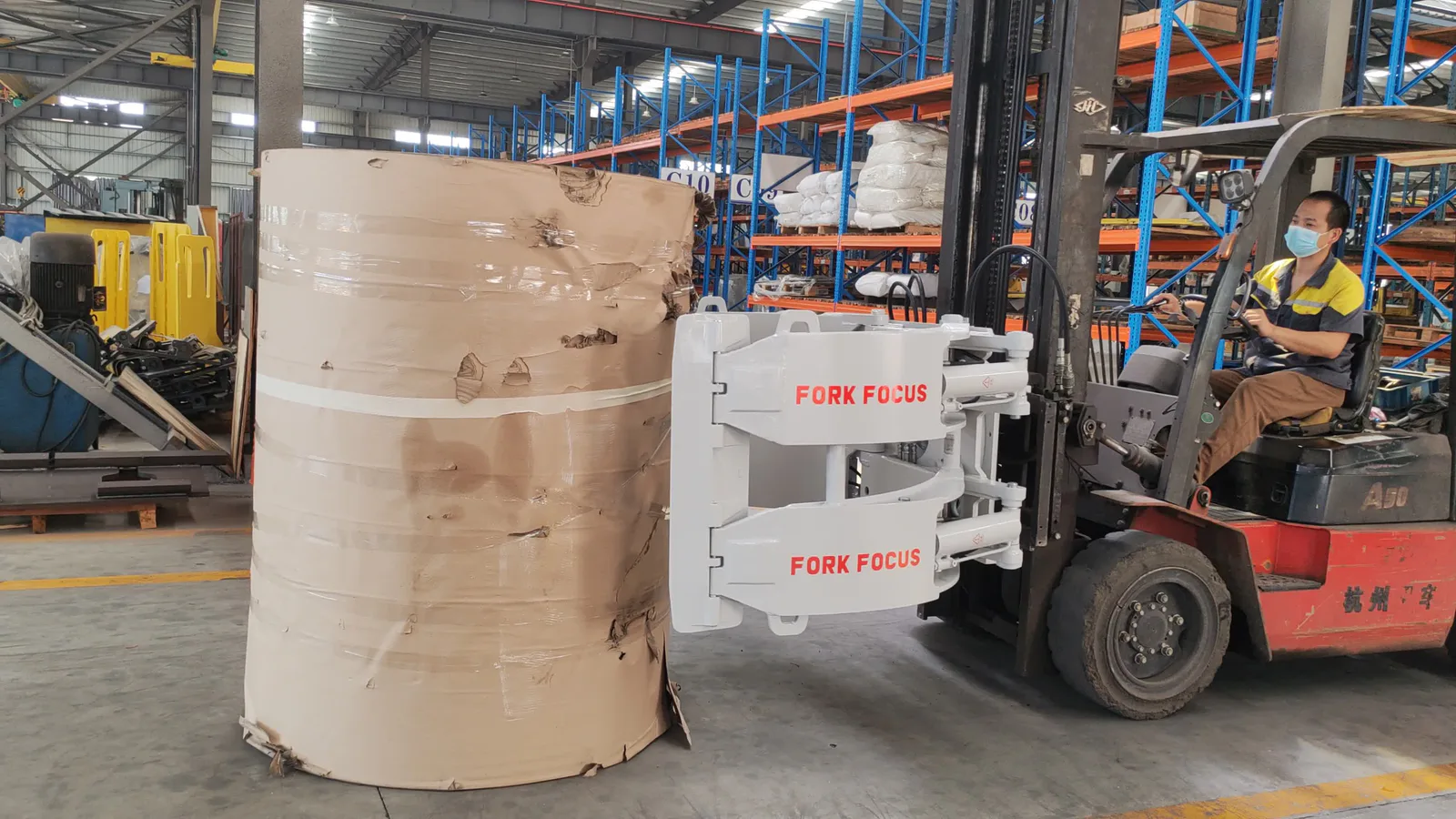
Step 1: Define the Job Before Choosing a Paper Roll Clamp
The first question is not “How much is the clamp?” It is “What job must this clamp finish every day?”
Common buyer task
Move 1 wrapped roll safely from storage to production, truck or container.
Real selection meaning
The clamp may need rotation, correct arm range, suitable pads and enough forklift residual capacity. If the truck has not been selected yet, review the complete ForkFocus forklift range together with the attachment requirement.
High-volume site
Paper mills and logistics sites may care more about cycle reduction and multi-roll handling. For a broader view, review the ForkFocus widely used forklift attachment guide.
Damage-sensitive site
Coated paper, tissue paper and unwrapped rolls need more attention to pad material and pressure distribution.
For most paper roll applications, 360-degree rotation is a basic working requirement because rolls often move between vertical and horizontal positions.
Step 2: Confirm Roll Data Before Discussing Price
Correct paper roll clamp selection depends on the roll information. The supplier cannot professionally choose the clamp structure, pads or hydraulic functions from forklift capacity alone.
Minimum and maximum roll diameter decide opening range and closing/contact range.
Width affects arm width, pad size and roll stability.
Weight affects clamp capacity, clamp force and forklift residual capacity.
Kraft, coated paper, newsprint and tissue paper react differently to pressure.
Plastic film, kraft wrapping, waxed surface or bare paper changes friction.
1 roll, 2 rolls or multiple rolls can require different arm structures.
Step 3: Choose the Paper Roll Clamp Type by Arm Structure
Paper roll clamps are not one universal product. The arm structure decides whether the clamp fits stable large rolls, small rolls, mixed diameters, single-roll handling or multiple-roll handling.
Fixed short arm
Best for stable roll programs where roll diameters are mostly on the larger side of the clamp range.
Moving short arm
Better for mixed diameters and smaller rolls because the short arm can be positioned for contact.
Solid long arm
Suitable for single-roll handling where roll sizes are relatively consistent.
Split long arm
Useful for 1–2 roll handling or when rolls with different diameters need separate pad contact.
Multi-roll clamp
Used where high-volume handling justifies higher complexity and capacity requirements.
Soft-paper setup
For tissue or low-density rolls, pad area and pressure distribution become more important.
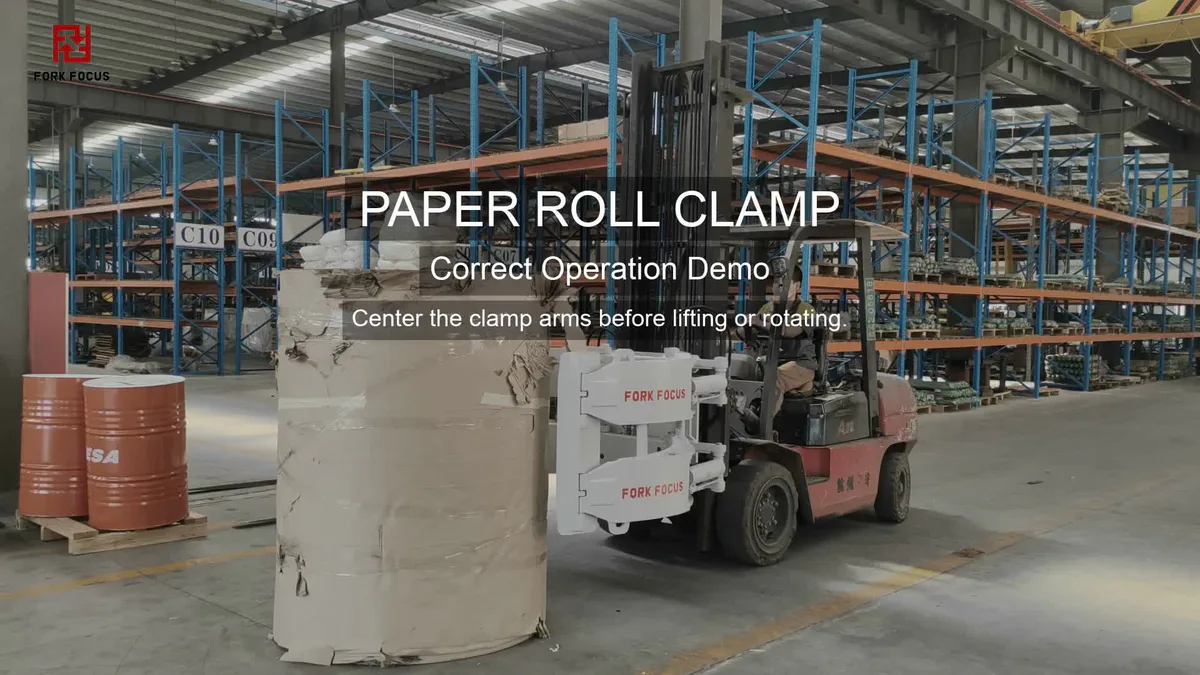
Step 4: Use Minimum Arm Range to Decide Fixed Short Arm or Moving Short Arm
A fixed short arm can be practical and cost-effective when the roll size program is stable and the rolls are mostly large.
A moving or positioned short arm becomes important when the customer handles a wide diameter range or smaller leftover rolls.
| Customer condition | Better starting point | Reason |
|---|---|---|
| Stable, mostly large rolls | Fixed short arm | Lower complexity and enough contact geometry. |
| Wide diameter range | Moving / positioned short arm | Short arm can adjust to smaller and larger rolls. |
| Small leftover rolls | Moving / positioned short arm | Small rolls often expose poor contact if the short arm cannot reposition. |
| 2 rolls at once | Split long arm / multi-roll type | Each roll needs stable contact, especially if diameters differ. |
If the minimum arm range is wrong, the clamp may contact the roll at a poor angle, create local pressure marks or lose grip during rotation.
Step 5: Match Contact Pads to Paper Type and Wrapping Material
The contact pad must balance friction, pressure distribution and surface protection. More clamp pressure is not automatically safer.
Kraft / industrial paper
Check friction and roll weight. Standard high-friction pads may be suitable depending on the application.
Plastic film wrapping
Focus on grip because the surface may be slippery during lifting or rotation.
Coated or white paper
Surface marks are more visible, so pad face and pressure distribution need review.
Tissue or soft roll
Use a soft-paper logic: larger contact area, controlled pressure and suitable pad material.
Step 6: Control Paper Roll Damage Before It Happens
Paper roll damage usually comes from a mismatch between roll, pad, clamp force, arm contact and operation.
Slipping
Check roll weight, surface friction, pad condition and clamping force.
Surface marks
Check pad material, pad wear, pressure distribution and paper sensitivity.
Edge damage
Check rotation control, contact position, stacking clearance and operator sequence.
Deformation
Check soft-paper density, pad area and over-clamping risk.
Wrapper tearing
Check pad face, friction surface, burrs, contamination and clamp pressure.
Unstable rotation
Check forklift capacity, load center, hydraulic function and floor condition.
The goal is not maximum clamping pressure. The goal is enough grip with controlled pressure for the actual paper roll.
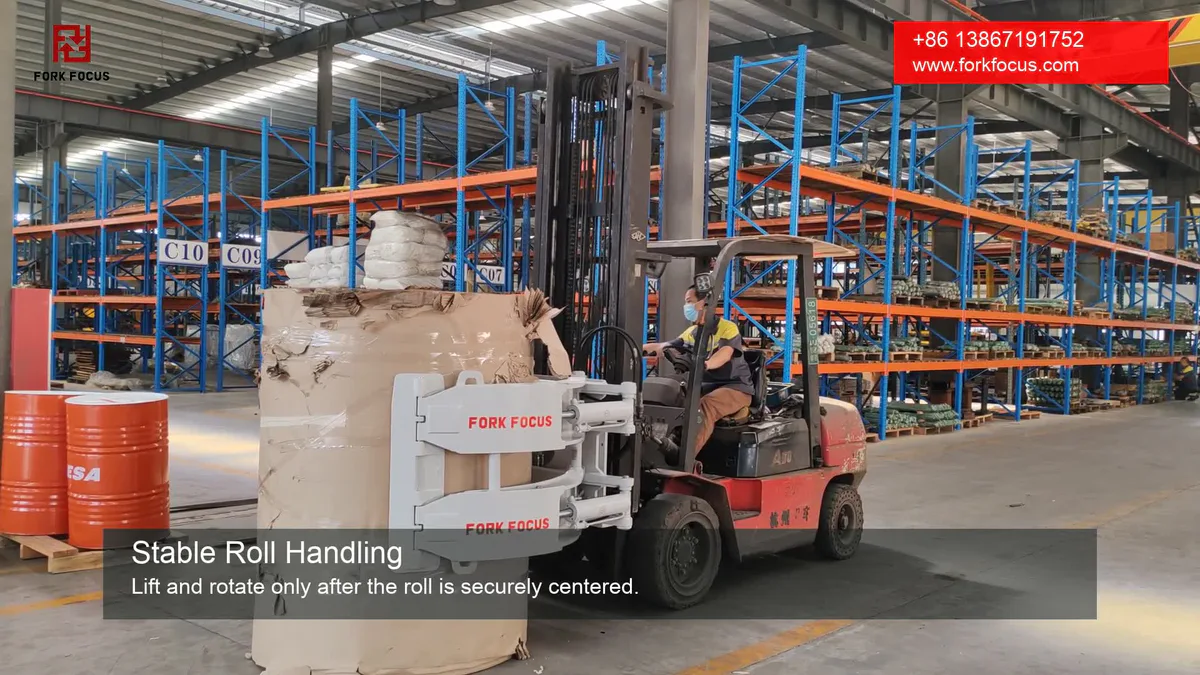
Step 7: Compare Single-Roll, Two-Roll and Multi-Roll Handling by Total Cost
A single-roll clamp is often the most practical starting point for printing plants, packaging factories and general warehouses.
A split-arm or multi-roll clamp can improve productivity in paper mills, ports and high-volume logistics, but it also increases complexity, attachment weight and forklift capacity requirements.
For related pallet-free handling options, compare the carton clamp, block clamp and other ForkFocus attachment solutions when the load is not a paper roll.
Choose single-roll when…
Roll sizes vary, daily volume is moderate, forklift capacity is limited or the site values simple operation.
Evaluate multi-roll when…
The site handles high daily volume, roll sizes are predictable and the forklift has enough residual capacity.
Step 8: Verify Forklift Capacity, Hydraulics, Operation and Maintenance
The paper roll clamp, roll and forklift must be checked as 1 working system. The clamp adds weight and moves the load center forward, so the truck’s usable capacity changes after installation.
Most paper roll clamp applications require clamping/opening and 360-degree rotation. Some configurations may also require side shifting, short-arm positioning or special hydraulic controls.
If the operation also needs load turning for non-roll goods, compare a dedicated forklift rotator rather than assuming a paper roll clamp is the right tool.
Wear, hardening, tearing, oil and uneven compression.
Cracks, deformation, looseness and uneven movement.
Smooth 360-degree rotation and no abnormal noise.
Cylinders, hoses, fittings and valves for leakage or damage.
Correct carriage mounting and secure locking components.
Forklift nameplate and attachment details available for review.
Worn pads often make operators increase clamp pressure, but higher pressure can create more paper damage. Replacing or matching the pad may solve the real problem more safely.
Plan LCL, FCL or DDP Options as Part of the Solution
A paper roll clamp purchase does not end with the attachment selection. Shipping cost, packing size, delivery timing and import method can affect the total landed cost.
ForkFocus supports the complete purchase process: product matching, packing review, shipment coordination and delivery planning, so the attachment can arrive safely and completely at the customer’s site.
LCL shipment
Suitable when 1 attachment or a small order does not justify a full container. ForkFocus can review packing size and shipment timing.
FCL shipment
Suitable when quantity, dimensions or project timing make a full container more economical or easier to control.
DDP review
For some destinations, ForkFocus can review whether DDP or a more flexible delivery route is available. Availability depends on destination and order details.
Because ocean freight has become a larger part of many import purchases, our professional logistics team can compare flexible shipping options from China and help customers reduce unnecessary freight cost where possible.
Prepare 1 Complete Enquiry for a Faster Quote
A complete enquiry allows ForkFocus to compare the correct clamp type first, explain trade-offs clearly and reduce repeated clarification emails.
Overall photo and close-up photo of the wrapping or contact surface.
Minimum diameter, maximum diameter and roll width.
Maximum roll weight and whether weight varies by product.
Paper type, density sensitivity and surface sensitivity.
1 roll, 2 rolls or multiple rolls per cycle.
Model, rated capacity, mast, carriage class and nameplate photo.
In Conclusion
A smart paper roll clamp selection is not only a product choice. It is a matching process between the roll, contact surface, arm structure, hydraulic functions and forklift residual capacity.
What you send us
- Roll photos: overall view and close-up wrapping/contact surface.
- Roll size: minimum diameter, maximum diameter and roll width.
- Roll weight: maximum roll weight and handling quantity per cycle.
- Paper details: paper type, wrapping material and surface sensitivity.
- Forklift data: model, capacity, mast, carriage class and nameplate.
- Shipping details: quantity, destination port or address, expected delivery timing and preferred trade term.
What ForkFocus checks
- Arm structure: fixed short arm, moving short arm, split arm or multi-roll type.
- Minimum range: whether the smallest roll can be clamped at the right contact angle.
- Pad selection: rubber pad, soft pad or special contact surface based on wrapping.
- Truck matching: hydraulic functions, mounting and residual capacity after installation.
- Operation sequence: rotation, arm opening and safe handling method.
- Shipping route: whether LCL, FCL or DDP review may reduce total landed cost.
Why this reduces risk
- Less paper damage: pad and clamp force are matched to the real roll.
- Better productivity: single-roll or multi-roll handling is compared by total cost.
- Fewer wrong purchases: the clamp is reviewed together with the forklift, not alone.
- Clearer quotation: ForkFocus can explain trade-offs before production.
- Lower landed-cost risk: our logistics team can compare more flexible shipping options and coordinate delivery planning.
- Practical support: photos, videos, nameplate and delivery information are enough to start the review.
If you are choosing between fixed short arm, moving short arm, split long arm or multi-roll handling, do not decide from price alone. ForkFocus should first review the arm-opening range, contact pads, operation sequence and forklift fit.
This is the advantage of a technical matching review: we help turn your roll details into a practical paper roll clamp configuration instead of guessing from a catalogue picture.
How ForkFocus Handles Your Paper Roll Clamp Enquiry
We review roll diameter range, width, weight, paper type and wrapping surface to understand the real handling need.
We compare fixed short arm, moving short arm, split arm and multi-roll options.
We check whether rubber pads, soft pads or special contact surfaces are needed.
We review carriage, hydraulic functions, mounting and residual capacity.
We explain trade-offs between price, damage control, productivity and complexity.
After order confirmation, we align the specification, drawing or key dimensions before production starts.
We review packing size, contact protection and loading requirements so the attachment is prepared for export handling.
We compare LCL, FCL or possible DDP routes based on quantity, packing size and destination.
We provide a practical clamp configuration, production confirmation points and shipping direction before final delivery.