
1.5–1.8 Tonne A Series Stand-on Reach Trucks
CQD15-AC5S and CQD18-AC5S compact stand-on reach trucks for shorter warehouse cycles, tight turning areas and cold-store projects.
Request a Warehouse ReviewDiscuss It on WhatsAppA compact reach truck for frequent on-and-off work
The stand-on layout reduces walking and boarding time on short warehouse routes. A 1,094 mm body width and 1,600–1,750 mm turning radius also help where staging areas are tighter.
This is not simply a smaller sit-down reach truck. Operator position, travel distance, floor condition and the number of stops per hour decide whether stand-on operation improves productivity.
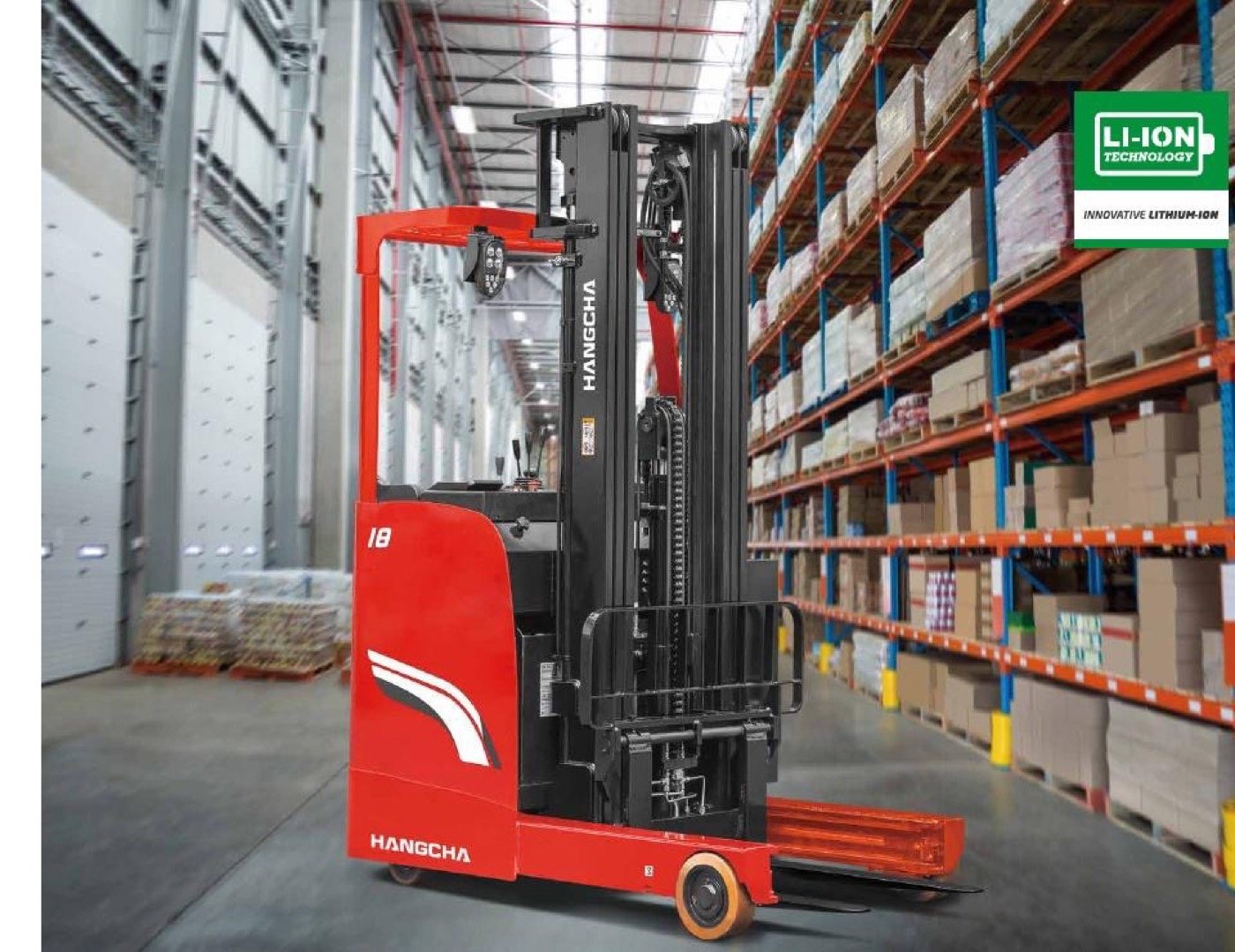
Models and working specifications
| Model | Rated capacity | Travel speed laden/unladen | Lift speed laden/unladen | Battery |
|---|---|---|---|---|
| CQD15-AC5S / CQD15-AC5S-F2 | 1,500 kg at 500 mm load centre | 9.5 / 10.5 km/h | 0.320 / 0.550 m/s | 48 V / 280 Ah |
| CQD18-AC5S / CQD18-AC5S-F2 | 1,800 kg at 500 mm load centre | 9.5 / 10.5 km/h | 0.300 / 0.530 m/s | 48 V / 280 Ah |
Standard lift is 3,000 mm and full-free triplex mast selections extend to 7,000 mm. With a sideshifter, the residual-capacity table requires a 200 kg deduction.
Stand-on A Series, sit-down A Series or XC Series?
| Selection point | A Stand-on 1.5–1.8 t | A Sit-down 1.2–2.0 t | XC Sit-down 1.4–2.5 t |
|---|---|---|---|
| Best working pattern | Frequent stops, shorter travel and tight staging areas | Routine pallet storage and moderate warehouse cycles | Longer routes, higher lift frequency and faster throughput |
| Travel speed | 9.5 / 10.5 km/h | 10.2 km/h | 14 km/h |
| Maximum listed mast route | 7,000 mm | 12,500 mm | 13,000 mm |
| Operator arrangement | Stand-on with low entry and back support | Seated | Seated with higher-output lithium package |
Review the sit-down A Series → Review the higher-output XC Series →
Five checks before choosing stand-on operation
The operating pattern shown in video should be compared with the customer’s actual stops, rack levels and transfer distance.
The truck is one part of the handling plan
ForkFocus integrates forklifts, spare parts and hydraulic attachments into unified material handling solutions. We confirm the mast height, forks, sideshift, battery, charger and planned service items before shipment.
Required forklift attachments, forklift spare parts, inspection records and delivery can be coordinated through our 360 Service and flexible shipment planning.
Frequently asked questions
When is a stand-on reach truck better than a seated model?
It is usually better on shorter routes with frequent stops and repeated entry or exit. Longer travel and high cycle rates may favour a seated XC Series truck.
Can a sideshifter be installed?
Yes, but the brochure requires a 200 kg capacity deduction with the sideshifter. Residual capacity at the real mast height must be recalculated.
Can this truck work in a freezer?
F2 versions are designed for cold-store environments down to -30 °C. The temperature transition, condensation, shift duration and charger location must be confirmed.
What are the normal commercial terms?
Standard small-capacity forklifts normally require about 30 days after technical confirmation. Warranty is normally 1–2 years or 2,000 working hours, whichever comes first; payment is normally 30% deposit and 70% before delivery.