
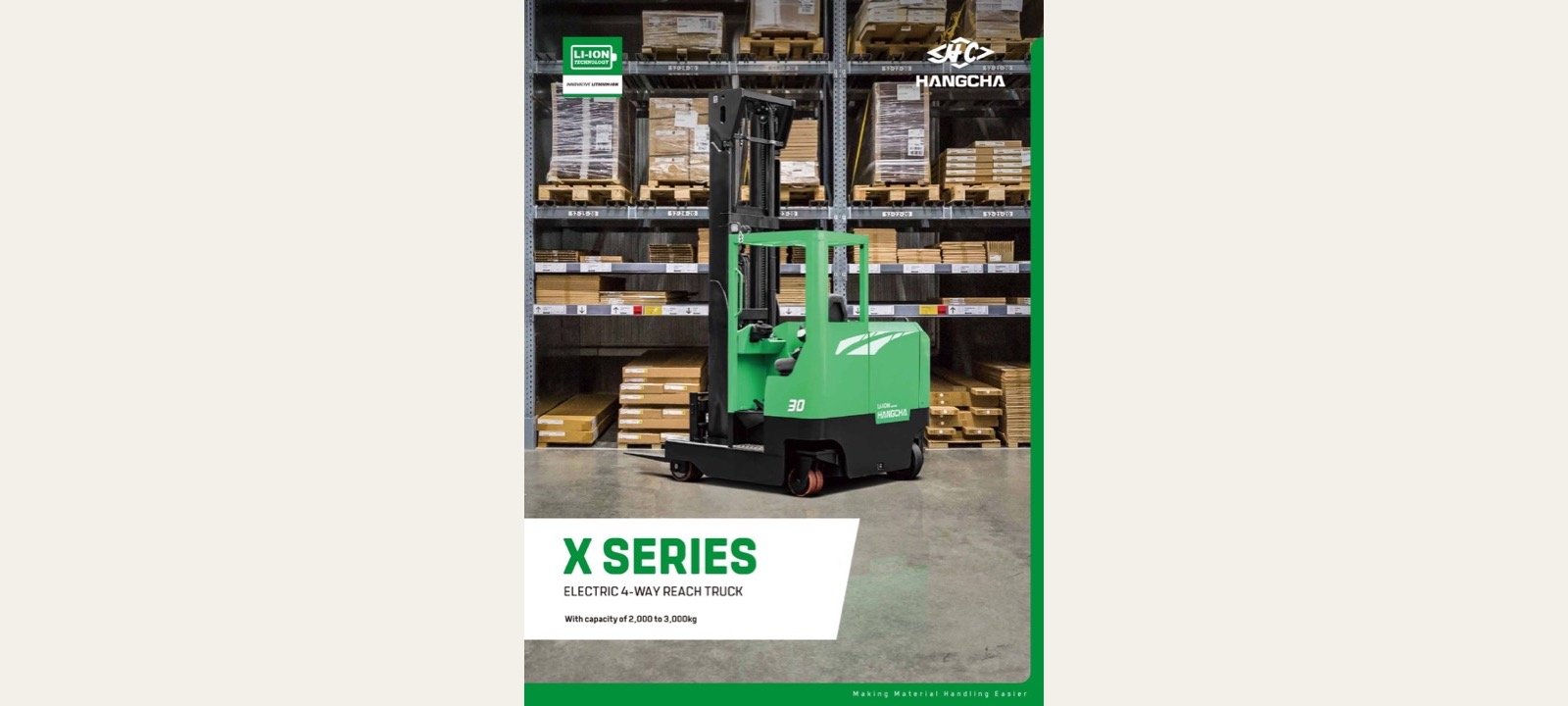
2.0–3.0 Tonne X Series Four-way Reach Trucks
CCD20, CCD25 and CCD30 four-way reach trucks for long timber, steel, pipe and sheet loads that need forward and sideways travel in narrow warehouse routes.
Request a Configuration ReviewDiscuss It on WhatsAppSimpler four-direction travel for regular long-load routes
A four-way reach truck changes between longitudinal and lateral travel so a long load can move through an aisle without a conventional turn. It is often the practical choice when the route is repetitive and diagonal travel is not required.
The CCD20, CCD25 and CCD30 share a 1,850 mm chassis width, 690 mm reach stroke and a mast route from 4,000 to 8,500 mm. Load length, bottom rack clearance and the actual 600 mm-plus load centre decide whether this chassis fits the job.
Models and published performance
| Model | Rated capacity | Travel speed laden/unladen | Lift speed laden/unladen | Battery |
|---|---|---|---|---|
| CCD20-XC5-ID | 2,000 kg at 600 mm | 11.5 / 12 km/h | 320 / 550 mm/s | 80 V / 250 Ah lithium |
| CCD25-XC5-ID | 2,500 kg at 600 mm | 11 / 12 km/h | 320 / 550 mm/s | 80 V / 346 Ah lithium |
| CCD30-XC5-ID | 3,000 kg at 600 mm | 10.5 / 12 km/h | 320 / 550 mm/s | 80 V / 346 or 456 Ah lithium |
The three models use an 8.1 kW drive motor and 21 kW lift motor. Reaching speed is 140/160 mm/s and loaded/unloaded gradeability is 9/12%.
Lead-acid CCD20-XC5-D, CCD25-XC5-D and CCD30-XC5-D versions are also listed. The battery route should be chosen from shift length, charging time, maintenance capacity and ambient temperature.
Compare the long-load truck routes
| Selection point | This page | Alternative X Series route | Heavier or simpler route |
|---|---|---|---|
| Steering route | Forward/reverse and left/right travel | Six travel modes including diagonal and 360-degree spin | Heavy side-loading platform with multidirectional steering |
| Rated range | 2.0–3.0 t | 2.0–3.0 t | 3.5–4.5 t |
| Best fit | Regular long-load aisles and repeatable routes | Confined layouts needing the highest manoeuvring flexibility | Heavier steel, pipe, timber and sheet loads |
| Main check | Cross-aisle and bottom rack clearance | Traffic plan for diagonal and spin movement | Route width, carriage width and floor loading |
The comparison is a routing guide. The actual load centre, mast height, aisle and rack clearance decide the approved configuration.
Five checks before the truck is released
Video supports a visual review of mast movement and warehouse clearance. Final selection still depends on the real load and site drawing.
The truck, attachment, parts and delivery plan are confirmed together
ForkFocus integrates forklifts, spare parts and hydraulic attachments into unified material handling solutions. We confirm mast height, fork carriage, forks, battery, charger, safety equipment and planned service items before production.
Required hydraulic attachments, forklift spare parts, inspection records and packing can be coordinated through our 360 Service and flexible shipment planning.
Frequently asked questions
What is the difference between four-way and all-directional travel?
Four-way travel covers longitudinal and lateral movement. The all-directional version adds diagonal, automatic direction change, right-angle and spin modes.
Can this truck handle six-metre steel or timber?
It can when load stability, centre of gravity, fork spread, carriage width and route clearance are approved. Load length alone is not enough to confirm the truck.
Which battery is better?
Lithium supports opportunity charging and lower routine maintenance, while lead-acid may suit fleets with established battery rooms. Shift pattern and charger supply decide the route.
Can the truck work outdoors?
Suitable paved routes may be possible, but rough or uneven yards require a separate chassis and tyre review.
What are the usual order terms?
Standard small-capacity forklifts normally require about 30 days after technical confirmation. Normal payment is 30% deposit and 70% balance before delivery; warranty is 1–2 years or 2,000 working hours, whichever comes first.