
2.0–2.5 Tonne A Series Stand-on Reach Trucks
CQD20-AC5S and CQD25-AC5S stand-on reach trucks for heavier pallets, short warehouse routes and frequent positioning at the rack face.
Request a Warehouse ReviewDiscuss It on WhatsAppHeavy pallets without moving to a larger sit-down chassis
The 2.0 and 2.5 tonne stand-on models add capacity while retaining the fast boarding and compact operator position used on short warehouse routes. Their 1,190–1,194 mm body width suits staging lanes where a larger seated truck becomes awkward.
Capacity alone does not decide the truck. Pallet depth, rack height, residual capacity, travel distance and the number of stops per hour determine whether a stand-on chassis remains the efficient choice.
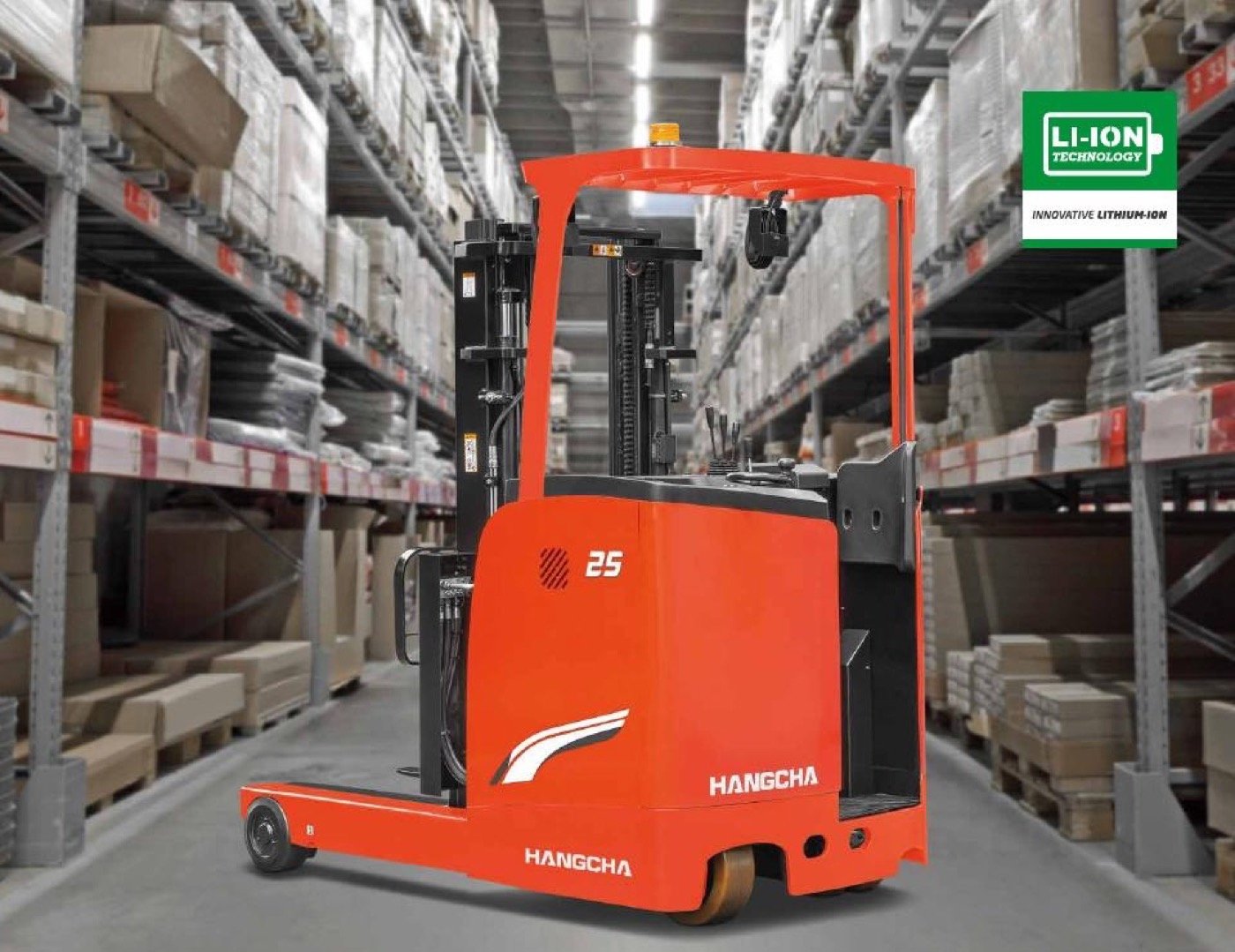
Models and working specifications
| Model | Rated capacity | Travel speed laden/unladen | Lift speed laden/unladen | Battery |
|---|---|---|---|---|
| CQD20-AC5S / CQD20-AC5S-F2 | 2,000 kg at 500 mm load centre | 10.5 / 10.5 km/h | 0.320 / 0.530 m/s | 48 V / 325 Ah |
| CQD25-AC5S / CQD25-AC5S-F2 | 2,500 kg at 500 mm load centre | 10.5 / 10.5 km/h | 0.280 / 0.510 m/s | 48 V / 325 Ah |
Both models use a 5 kW AC travel motor and an 11 kW AC lift motor. Standard lift is 3,000 mm, while full-free triplex mast selections extend to 7,000 mm.
The listed turning radius is 1,755 mm for the 2.0 tonne model and 1,950 mm for the 2.5 tonne model. A fitted sideshifter requires a 200 kg deduction from the published residual-capacity chart.
Which A or XC reach truck fits the duty?
| Selection point | A Stand-on 2.0–2.5 t | A Stand-on 1.5–1.8 t | XC Sit-down 1.4–2.5 t |
|---|---|---|---|
| Typical route | Heavier pallets, short transfer distance and frequent stops | Lighter pallets, tighter turning area and very frequent entry or exit | Longer travel, taller rack work and higher cycle demand |
| Travel speed | 10.5 km/h | 9.5 / 10.5 km/h | 14 km/h |
| Lift motor | 11 kW AC | 11 kW AC | 20 kW AC |
| Maximum listed mast route | 7,000 mm | 7,000 mm | 13,000 mm |
| Operator arrangement | Stand-on, heavier chassis | Stand-on, more compact chassis | Seated, higher-output lithium package |
Compare the 1.5–1.8 tonne A Series → Compare the higher-output XC Series →
Five checks before confirming the truck
Use the operating pattern in the video as a reference, then compare it with the actual rack height, transfer distance, floor condition and number of pallet cycles.
Forklift, parts and attachment planning in one order
ForkFocus integrates forklifts, spare parts and hydraulic attachments into unified material handling solutions. We confirm the mast height, forks, sideshift, battery, charger, cold-store package and planned service items before shipment.
Required forklift attachments, forklift spare parts, inspection records and delivery can be coordinated through our 360 Service and flexible shipment planning.
Frequently asked questions
When should we choose the 2.5 tonne model instead of the 2.0 tonne model?
Choose by residual capacity at the actual mast height, not by floor-level capacity alone. The 2.5 tonne chassis also has a larger turning radius, so aisle geometry must be checked before moving up in capacity.
Is the A Series stand-on truck suitable for long-distance travel?
It can travel at 10.5 km/h, but the stand-on layout is normally selected for short routes and frequent stops. Longer continuous travel and high cycle demand often justify a seated XC Series truck.
Can a sideshifter be installed?
Yes, but the published data requires a 200 kg capacity deduction with the sideshifter. The residual-capacity chart must be recalculated at the real mast height and load centre.
Can it work in a freezer?
F2 versions are listed for cold-store operation down to -30 °C. Battery temperature, condensation, warm-room transitions and charger position still require project review.
What are the usual delivery, payment and warranty terms?
Standard small-capacity forklifts normally require about 30 days after technical confirmation. Normal payment is 30% deposit and 70% balance before delivery; warranty is 1–2 years or 2,000 working hours, whichever comes first, with special terms reviewed for special orders.