
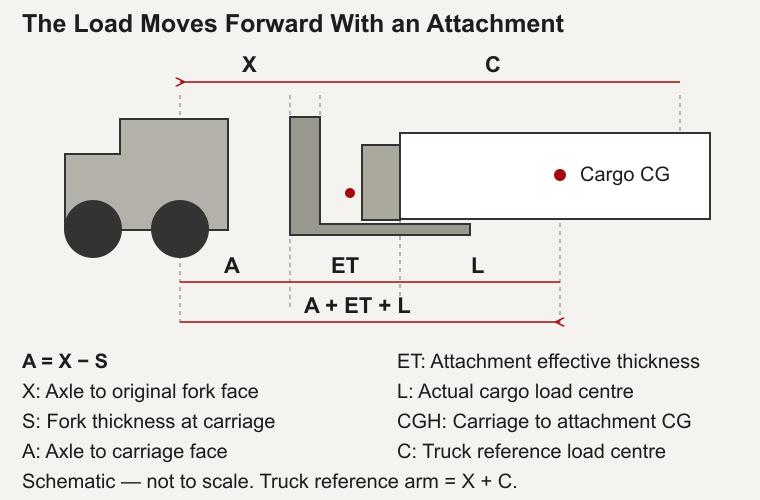
The nameplate capacity belongs to a defined truck, mast, height and load centre. A fitted attachment adds its own mass and moves the load forward. Buyers need the combined result before approving a truck and attachment.
Use The Excel-Based Calculation With Verified Inputs
G = [Q × (X + C) − M × (A + CGH)] ÷ (A + ET + L)
The formula is the existing ForkFocus calculator baseline. It is a calculation aid, not a replacement for the exact truck and mast load chart.
| G | Calculated residual truck capacity with the attachment, kg |
|---|---|
| Q | Truck capacity at the selected mast height and reference load center C, kg |
| X | Front axle center to fork face, mm |
| C | Truck reference load center, mm |
| S | Fork thickness, mm; A = X − S |
| M | Attachment mass, kg |
| CGH | Attachment horizontal center of gravity, mm |
| ET | Attachment effective thickness, mm |
| L | Actual load center of the cargo, mm |
Compare The Two Independent Limits
The calculated G is one truck-side limit. The attachment’s own rated capacity at its stated load condition is another. The working load must satisfy both, with the exact mast, height, load centre and configuration confirmed by the applicable technical evidence.
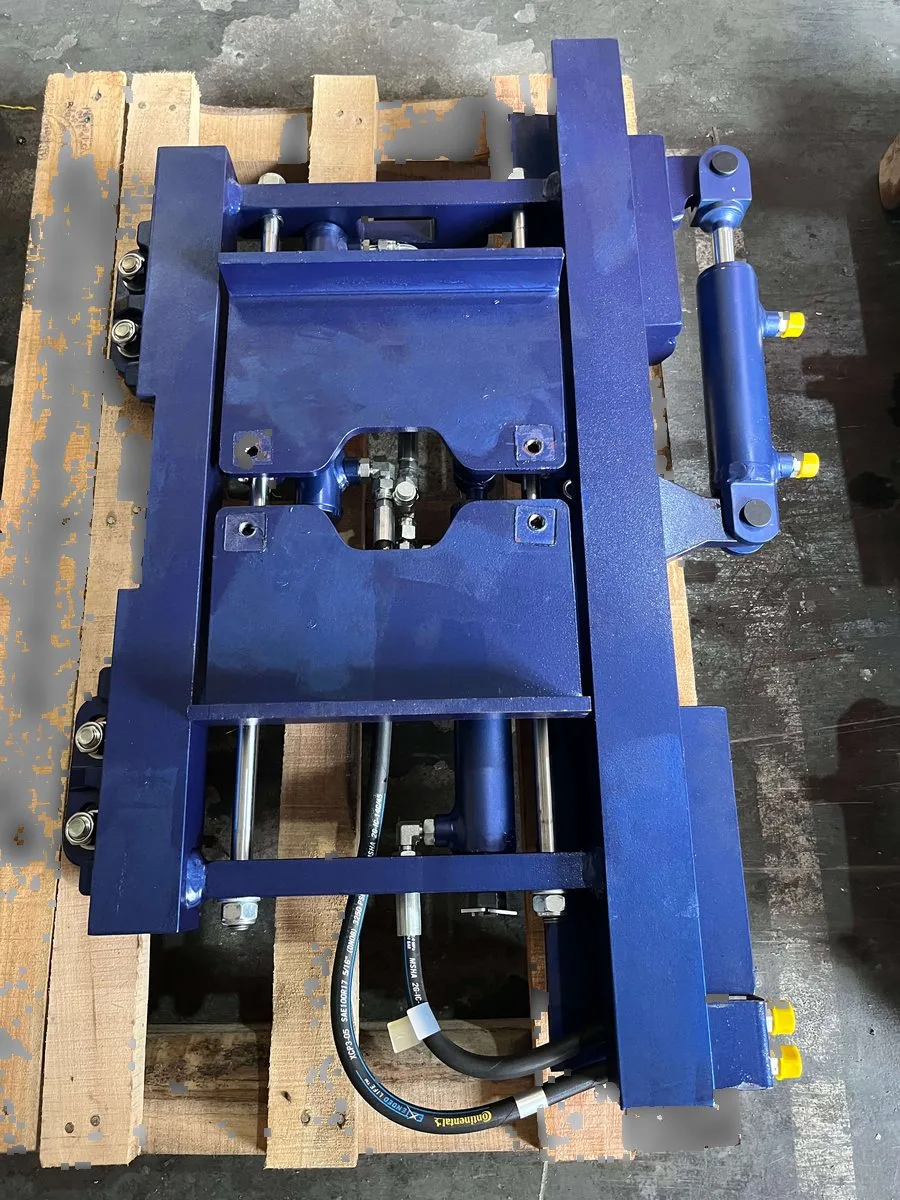
Compare ForkFocus forklift attachments · Plan seals, hoses and wear parts
Worked Example: A 3,000 kg Reference Truck With An Attachment
This is an arithmetic example, not a capacity approval for a particular forklift. The following assumed inputs show how attachment weight and load position change the calculation.
| Truck inputs | Attachment and load inputs |
|---|---|
| Q = 3,000 kg; X = 480 mm | M = 500 kg; CGH = 300 mm |
| C = 500 mm; S = 50 mm | ET = 100 mm; L = 500 mm |
| A = X − S = 430 mm | Working arm = 430 + 100 + 500 = 1,030 mm |
| Calculation | Result |
|---|---|
| Truck reference moment | 3,000 × (480 + 500) = 2,940,000 kg·mm |
| Attachment moment | 500 × (430 + 300) = 365,000 kg·mm |
| Remaining moment | 2,940,000 − 365,000 = 2,575,000 kg·mm |
| Combined capacity G | 2,575,000 ÷ 1,030 = 2,500 kg |
The calculated truck-side result is 2,500 kg for these inputs. The attachment must independently have a suitable rated capacity. The actual truck chart must also support Q at the required lift height and reference load centre C.
A longer load changes the answer. Keeping all other inputs the same but increasing L to 600 mm gives 2,575,000 ÷ 1,130 = 2,278.76 kg before display rounding.
Try these inputs in the forklift attachment capacity calculator. For your own quotation, send the load chart, attachment drawing, load weight and lift height to ForkFocus.