
Electric Stackers for Pallet Racking and Production Supply
Walkie, platform, rider, initial-lift, reach and counterbalanced stackers are selected by pallet entry, lift height, aisle width and residual capacity.
The mast and support-leg layout decide the application
A standard support-leg stacker is efficient with open-bottom pallets. Closed-bottom pallets, low pallets or special stillages may require a reach-fork, moving-mast or counterbalanced chassis.
Walkie and platform
CDD walkie and platform models cover common pallet stacking where route length and throughput determine the operator position.
Initial lift and double deck
Initial-lift and double-pallet configurations improve ramp clearance or allow two loads, but change residual capacity and load positioning.
Reach and counterbalanced
CQDB reach and CPDB counterbalanced stackers handle pallets that cannot accept standard support legs beneath the load.
A, X and XA stackers are not interchangeable
| Family | Practical selection logic |
|---|---|
| A Series | Wide configuration coverage, including basic, high-performance, initial-lift, reach, moving-mast and counterbalanced variants. |
| X Series | Higher-duty lithium routes with rider, initial-lift and double-pallet options for more intensive warehouse cycles. |
| XA Series | Compact walkie and mini configurations for straightforward daily stacking and controlled indoor routes. |
The series comparison is completed only after the pallet opening, lift height, aisle, ramp use and cycle rate are known.
Selection checks that prevent expensive mistakes
We confirm the pallet opening, fork section, support-leg spacing, mast-lowered height, free lift, lift height, residual capacity and aisle width. For cold storage, ramps or multiple shifts, the tyre, battery, charger and protection package also change.
ForkFocus integrates forklifts, planned spare parts and approved load-handling attachments into one material handling solution. We coordinate the machine, service items, documents, packing and delivery plan.
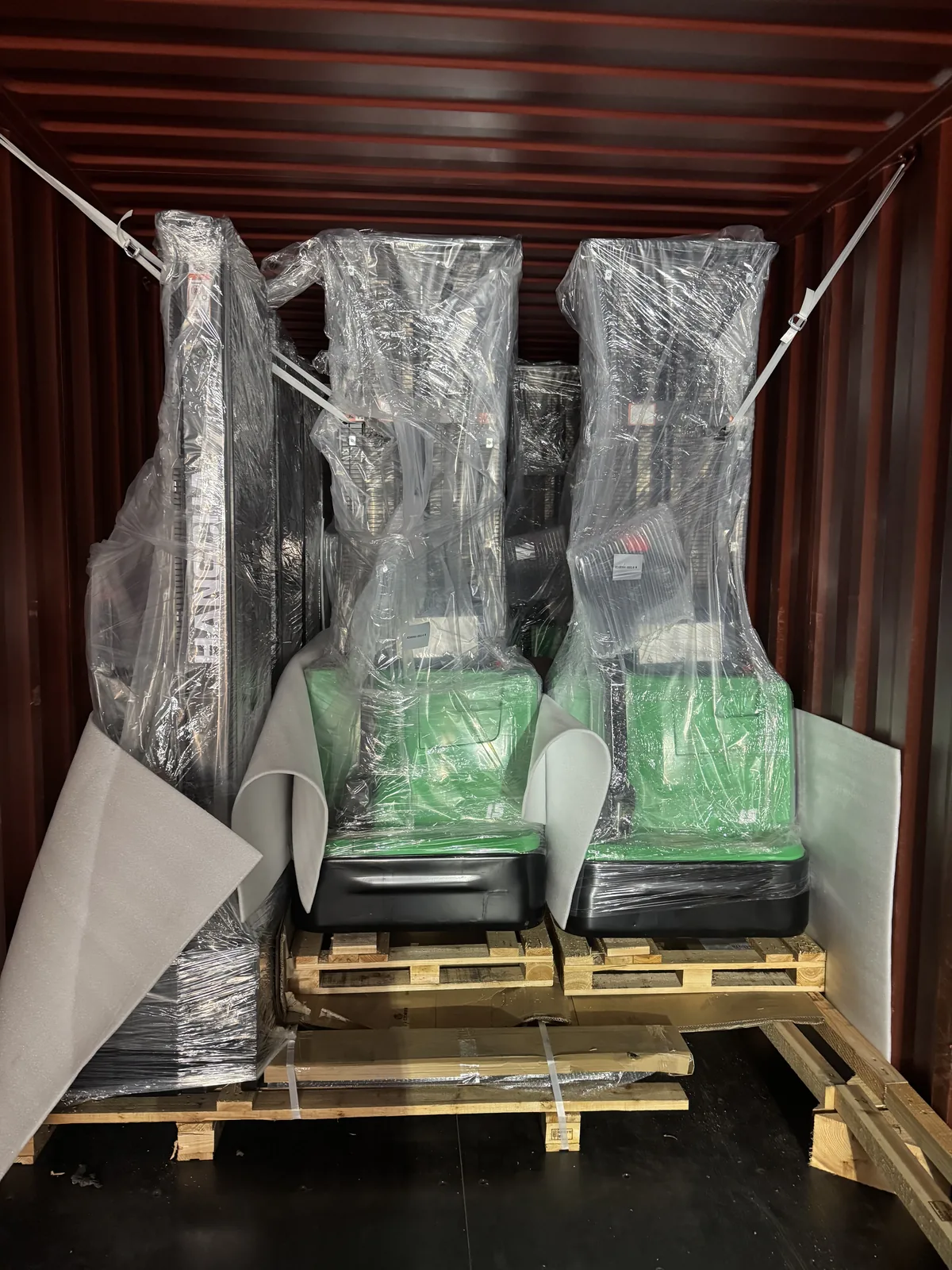
Check the complete truck before shipment
The real machine confirms the fork and support-leg arrangement, operator position, battery access, controls and service points that are easy to miss in a specification table.
ForkFocus records the agreed configuration and coordinates planned service parts and shipment documents with the truck.
Models and configurations
Stacker selection starts with pallet construction and residual capacity. Model codes separate walkie, platform, rider, initial-lift, moving-mast, reach-fork, counterbalanced and double-deck arrangements.
A Series · 104 model codes
A2 Series · 2 model codes
XA Series · 59 model codes
X Series · 29 model codes
Why Hangcha
Hangcha offers different chassis layouts for pallets that cannot all be handled by a standard support-leg stacker.
A and A2 cover broad standard and upgraded configurations. XA provides compact lithium routes, while X Series is suited to more intensive rider, initial-lift and double-pallet work.
This makes it possible to match pallet opening, mast height, aisle width, residual capacity and route intensity without treating every stacker as the same machine.
Why ForkFocus
We review the pallet, rack and travel route before fixing the stacker construction.
Support-leg spacing, fork section, mast-lowered height, free lift, lift height, residual capacity, aisle, ramp, battery and charger are confirmed together.
ForkFocus can coordinate the stacker with forklift spare parts, suitable Forklift Attachments, 360 service and shipment planning.
Electric Stacker FAQ
Why can a stacker lift less at full height?
Rated capacity is normally stated at a defined load centre and lower height. Residual capacity falls as lift height, load centre and attachment weight increase.
When is a counterbalanced stacker required?
Use it when support legs cannot enter beneath the pallet or stillage. It behaves more like a compact forklift but usually needs more aisle space than a support-leg stacker.
What does initial lift solve?
Initial lift raises the support legs to improve ramp and uneven-floor clearance. It is not the same as mast lift and must be checked with the load and route.
Send the pallet drawing and rack dimensions
Share pallet openings, maximum load, lift height, aisle width, lowest overhead clearance and daily cycles. We will compare the correct stacker construction and series.
From one truck to a complete pallet-handling plan
ForkFocus integrates forklifts, spare parts and Forklift Attachments into unified material handling solutions. We confirm pallet entry, route distance, ramp condition, mast height and battery plan before recommending the truck configuration.
Wear parts and service items can be prepared with the equipment order. Where the application requires more than forks, our forklift attachments and forklift spare parts are checked against the chassis, while shipment planning coordinates the truck and related items.