

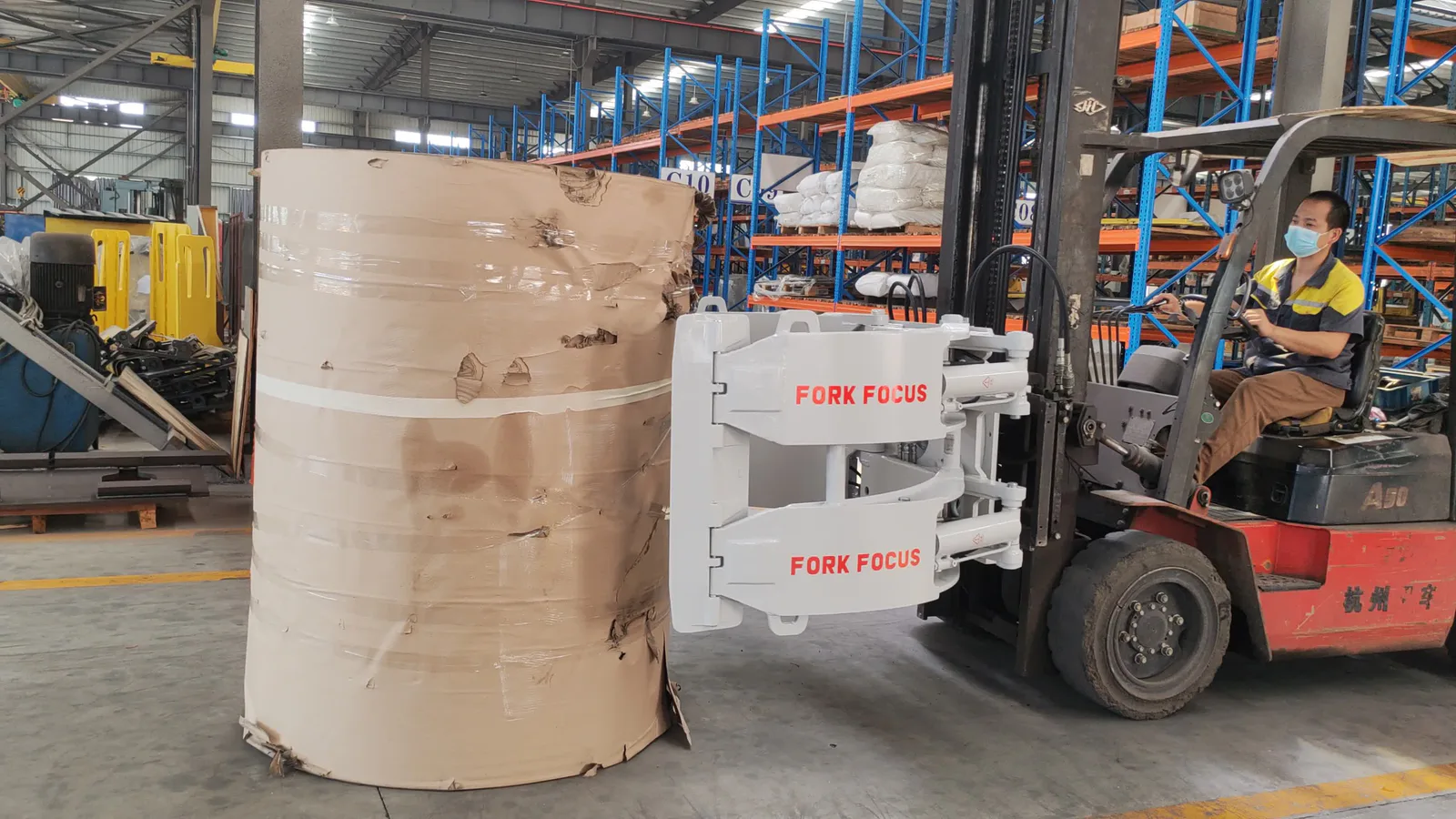
A paper roll clamp works under repeated clamping, lifting and 360-degree rotation.
Regular inspection is necessary because small wear points can lead to roll slipping, surface damage, hydraulic leakage or unstable handling.

Watch a ForkFocus Paper Roll Clamp in Operation
See how a purpose-built paper roll clamp controls and rotates the load during a real handling cycle.
Inspect the Contact Pads
You can also compare the wider ForkFocus forklift attachment range when the operation handles more than paper rolls.
The first item to inspect is the contact pad.
Pads are directly responsible for grip and surface protection.
Check whether the pad surface is worn, hardened, torn, contaminated with oil, or unevenly compressed.
A worn pad may require more clamp force to hold the same roll, which can increase the risk of paper damage.
If the customer changes from one paper type to another, pad suitability should also be reviewed.
Check the Clamp Arms
For the complete load-data checklist, review our paper roll clamp selection guide.
The second item is the clamp arm structure.
Inspect arms for deformation, cracks, abnormal looseness or uneven movement.
The arms should open and close smoothly.
If the clamp uses split arms or independent arm control, both sides should respond consistently and hold the roll evenly.
Test the 360-Degree Rotation System
Unusual roll sizes, wrappers or handling patterns may require custom forklift attachment engineering before production.
The third item is the 360-degree rotation system.
Rotation should be smooth, controlled and free from abnormal noise.
Unstable rotation can affect load control, especially when the roll is transferred between vertical and horizontal positions.
Operators should avoid sudden rotation with the load raised high.
Inspect the Hydraulic System
Procurement teams can use this forklift attachment buying guide to compare quotations on the same basis.
The fourth item is the hydraulic system.
Check cylinders, hoses, fittings and valves for leakage or damage.
Hydraulic leakage is not only a maintenance issue; it can reduce clamp force and create a slipping risk.
Hoses should be routed and protected so they are not pinched during opening, closing or rotating movement.
Verify Mounting and Locking
Operator procedures should also follow these attachment safety practices.
The fifth item is mounting and locking.
Confirm that the paper roll clamp is correctly mounted to the forklift carriage and that locking components are secure.
Any looseness between the attachment and forklift can affect control and safety.
Confirm Forklift Capacity Information
Measure cycle-time improvements with the practical steps in this attachment efficiency guide.
The sixth item is forklift capacity information.
A paper roll clamp adds weight and moves the load center forward.
OSHA guidance notes that attachments can affect forklift stability, capacity and visibility.
Therefore, the forklift should have proper capacity information for the attachment and load combination.
Operators should not rely only on the forklift’s capacity without attachment.
Daily Paper Roll Clamp Checklist
Very heavy rolls should be evaluated together with these heavy-load attachment solutions.
A simple daily checklist can include:
Match Inspection Frequency to the Application
For whole-life cost decisions, compare the attachment features that save time and money that affect service and productivity.
Maintenance should match the application.
A paper mill or port operation with high cycle frequency needs more frequent inspection than a low-volume warehouse.
If rolls are valuable, delicate or easily marked, pad condition should be checked more often.
- Contact pads clean and not excessively worn
- Clamp arms open and close evenly
- Rotation works smoothly
- No hydraulic oil leakage
- Hoses and fittings are secure
- Mounting hooks and locks are in place
- No visible cracks or deformation
- Forklift nameplate/capacity information is available
- Operator understands clamp, rotate and load limits
In Conclusion
A paper roll clamp is a productivity tool, but it must be maintained as a load-bearing and load-controlling attachment.
Proper maintenance helps reduce roll damage, improves operator control and extends attachment service life.