

When choosing a paper roll clamp, many customers first ask for capacity and price.
A better question is: how many rolls do you need to handle per cycle, and does the forklift have enough capacity to do it safely?
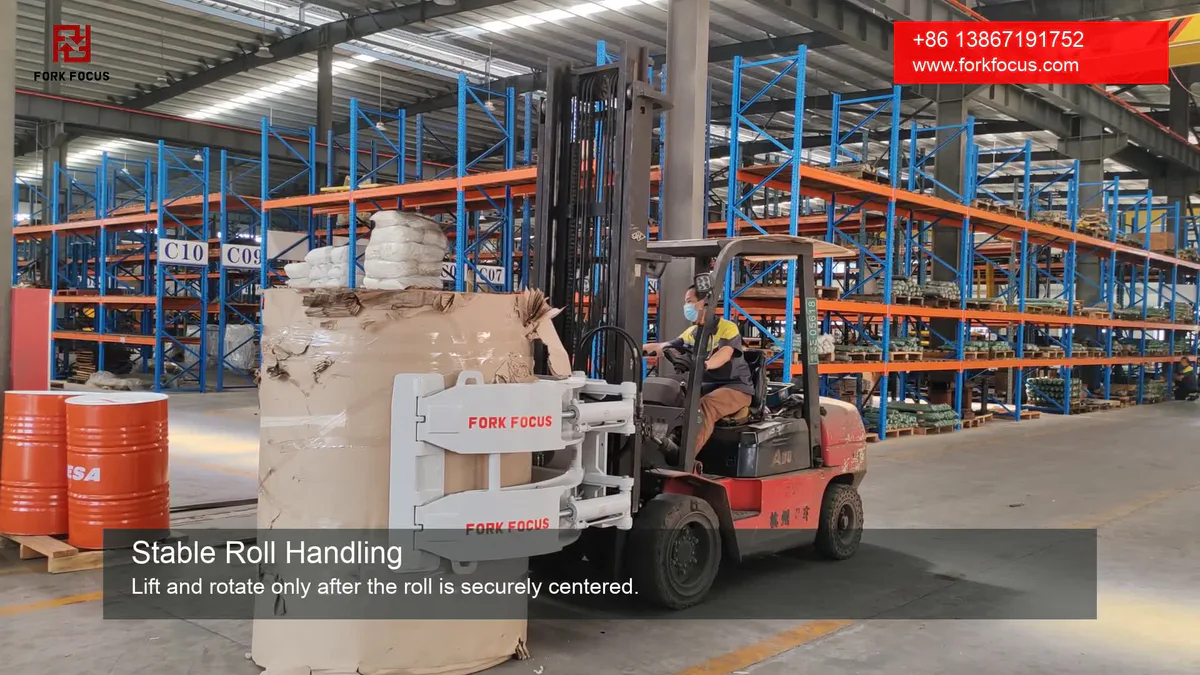
Watch a ForkFocus Paper Roll Clamp in Operation
See how a purpose-built paper roll clamp controls and rotates the load during a real handling cycle.
When a Single-Roll Clamp Makes Sense
You can also compare the wider ForkFocus forklift attachment range when the operation handles more than paper rolls.
A single-roll paper roll clamp is usually the most practical choice for printing plants, packaging factories, warehouses and general paper handling.
It is simpler, lighter and easier to match with standard forklifts.
If the operation handles one roll at a time, or roll sizes change frequently, a single-roll clamp may provide the best balance between cost, flexibility and maintenance.
When Multi-Roll Handling Pays
For the complete load-data checklist, review our paper roll clamp selection guide.
A multi-roll paper roll clamp is designed for operations where productivity is more important than attachment simplicity.
Paper mills, ports, stevedoring operations and high-volume paper warehouses may need to handle two or more rolls in one cycle.
In this situation, a multi-roll clamp can reduce travel cycles and improve loading efficiency.
Check Forklift Capacity and Stability
Unusual roll sizes, wrappers or handling patterns may require custom forklift attachment engineering before production.
However, multi-roll handling is not automatically the better choice.
The total load increases quickly when several rolls are clamped together.
The forklift must have enough residual capacity after the attachment is installed.
The operator also needs good visibility and enough aisle or loading space to control a wider and heavier load.
Plan for Different Roll Diameters
Procurement teams can use this forklift attachment buying guide to compare quotations on the same basis.
Another important point is roll diameter variation.
If the customer handles rolls with different diameters at the same time, the clamp arm structure becomes more important.
Some multi-roll clamps use split arms or independent arm control so the clamp can adapt to different roll combinations.
This is useful in high-volume applications, but it also increases attachment complexity and cost.

Match the Contact Pads
Operator procedures should also follow these attachment safety practices.
Pad selection is still critical.
Whether handling one roll or several rolls, the clamp pads must match the paper type and outside packaging.
A multi-roll clamp handling kraft paper, coated paper or plastic-wrapped rolls may require different pad surfaces from a clamp handling tissue paper or newsprint.
Use a Practical Selection Logic
Measure cycle-time improvements with the practical steps in this attachment efficiency guide.
For cost-effective selection, ForkFocus recommends using the following logic:
- If the customer handles one roll per cycle, has moderate handling volume and uses a standard forklift, start with a single-roll 360-degree paper roll clamp.
- If the customer handles high daily volume, loads containers or trucks repeatedly, and the forklift has sufficient capacity, evaluate a multi-roll clamp.
- If roll diameters vary within the same handling cycle, confirm whether split arms or independent arm control are needed.
- If the outer packaging is slippery or easily marked, confirm pad material before confirming clamp model.
Compare Total Handling Cost
Very heavy rolls should be evaluated together with these heavy-load attachment solutions.
The right paper roll clamp should reduce total handling cost, not only purchase cost.
A lower-priced clamp that causes roll damage, frequent rehandling or forklift overload is not economical.
A larger multi-roll clamp that exceeds the real application need is also not economical.
For whole-life cost decisions, compare the attachment features that save time and money that affect service and productivity.
Single-roll and multi-roll clamps fit different load patterns
Roll quantity, diameter range, combined weight and handling frequency determine whether one or several rolls should be controlled in each cycle.
Single-roll clamp
One roll is controlled in each cycle. Confirm the complete diameter and weight range, roll orientation, pads and required rotation.
Multi-roll clamp
Several rolls may be handled together only when the arm arrangement, combined weight, roll-size combinations and visibility are verified.
- Roll pattern
- Single roll, stacked rolls or multiple rolls handled together.
- Dimensions
- Minimum and maximum diameter, width and orientation.
- Load
- Maximum individual and combined roll weight.
- Clamp
- Arm arrangement, opening range, pads, rotation and pressure control.
- Truck
- Carriage, hydraulics, visibility and working-point capacity.
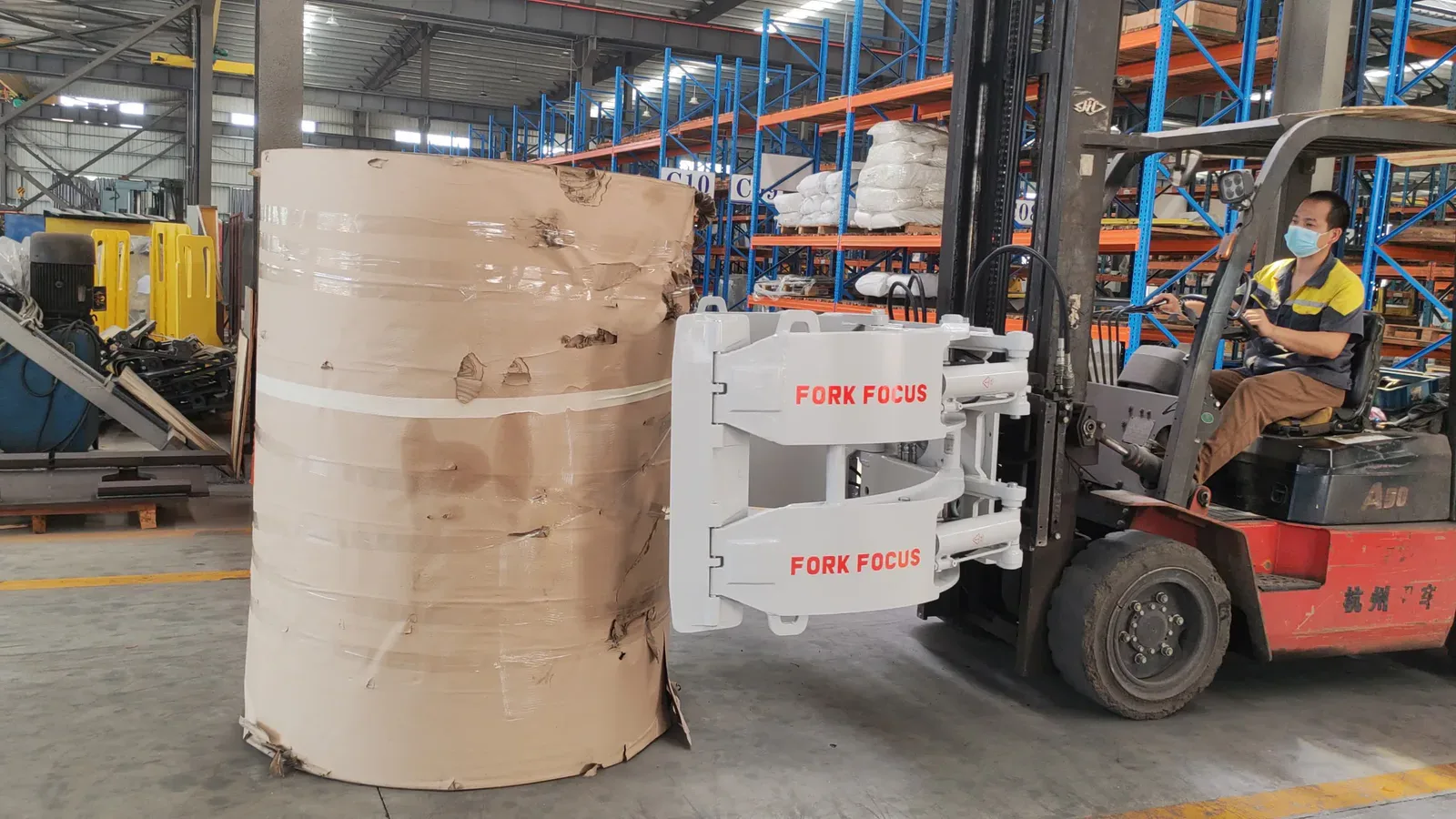
electric forklift range
Electric counterbalance trucks can suit indoor paper operations; outdoor or sustained heavy-duty work may require an IC alternative.
Paper roll clamp product route
The clamp must cover the roll pattern without unacceptable damage or slip, while the forklift retains adequate capacity.
Clamp rating and forklift residual capacity must pass independently.
Compare the complete roll pattern and combined weight before choosing a single-roll or multi-roll clamp arrangement.