

Paper rolls are heavy, round and easily affected by surface pressure.
Even when the forklift operator is experienced, the wrong paper roll clamp configuration can cause roll deformation, edge damage, wrapper tearing or telescoping.
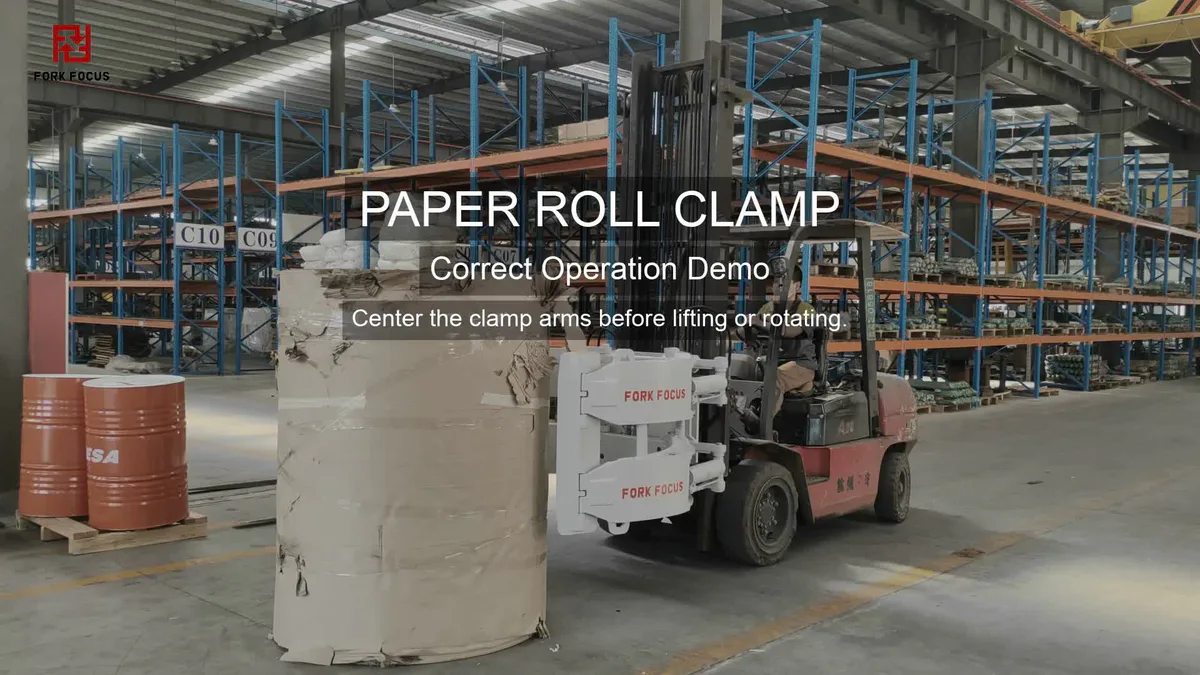
Watch a ForkFocus Paper Roll Clamp in Operation
See how a purpose-built paper roll clamp controls and rotates the load during a real handling cycle.
Control Clamp Force
You can also compare the wider ForkFocus forklift attachment range when the operation handles more than paper rolls.
One common cause is incorrect clamp force.
If the clamp force is too low, the roll may slip during lifting, turning or traveling.
If the force is too high, the paper surface or core area may be compressed.
This is especially important for soft tissue paper, coated paper and rolls with delicate outer packaging.
The goal is not “maximum pressure”; the goal is controlled pressure that is suitable for the roll weight and paper type.
Choose the Correct Contact Pad
For the complete load-data checklist, review our paper roll clamp selection guide.
The second cause is wrong contact pad selection.
The clamp pad is the part that directly touches the roll, so its material and shape matter.
Rubber pads can increase friction for many paper grades.
Urethane pads may be suitable for certain coated, kraft or wrapped rolls.
Tissue rolls may require special pad profiles depending on roll density.
Using one pad type for every paper roll is not a professional approach.
Maintain Full Pad-to-Roll Contact
Unusual roll sizes, wrappers or handling patterns may require custom forklift attachment engineering before production.
The third cause is poor pad-to-roll contact.
If the clamp does not match the roll diameter, the pads may contact the roll unevenly.
Small contact areas increase local pressure and can mark or deform the roll.
A properly selected clamp should hold the roll with stable contact across the pad surface.
Match the Clamp Opening Range
Procurement teams can use this forklift attachment buying guide to compare quotations on the same basis.
The fourth cause is unsuitable clamp size.
A clamp with insufficient opening range cannot handle larger rolls safely.
A clamp that is much larger than needed may increase attachment weight and reduce forklift capacity without giving practical benefit.
Correct sizing protects both the roll and the forklift.
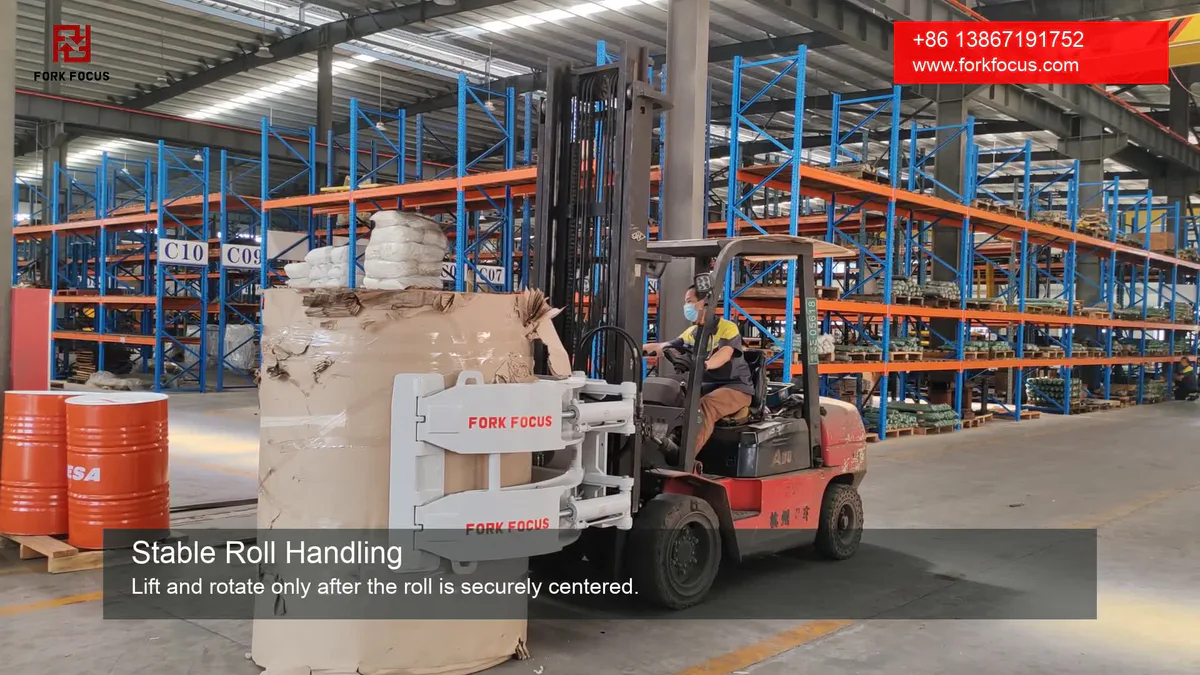
Control Rotation and Travel
Operator procedures should also follow these attachment safety practices.
The fifth cause is operating practice.
Paper roll clamps normally require 360-degree rotation, but rotation must be controlled.
Sudden rotation, uneven floor conditions, fast travel while raised, or turning with a high load can increase instability.
The operator must understand the attachment’s working limits, not only the forklift’s rated capacity.
Account for the Outer Packaging
Measure cycle-time improvements with the practical steps in this attachment efficiency guide.
The sixth cause is ignoring the roll packaging.
Plastic-wrapped rolls, kraft-wrapped rolls, waxed stock and bare paper do not have the same friction.
A roll that looks similar in size and weight may require a different pad surface because the wrapper changes how the clamp grips the load.
Pre-Operation Damage Checklist
Very heavy rolls should be evaluated together with these heavy-load attachment solutions.
To reduce paper roll damage, ForkFocus recommends checking these points before selecting or using a paper roll clamp:
- Does the clamp opening range match the actual roll diameter?
- Is the clamp capacity suitable for the heaviest roll?
- Is the pad material matched to the paper type and wrapper?
- Is the clamp force adjusted for the load?
- Does the forklift have enough residual capacity with the attachment installed?
- Are the pads, cylinders and hydraulic hoses inspected regularly?
- Is the operator trained for clamp and rotation functions?
In Conclusion
For whole-life cost decisions, compare the attachment features that save time and money that affect service and productivity.
Paper roll handling is a technical application.
A good clamp does not only lift the roll; it controls pressure, contact area, friction and rotation through the whole handling cycle.