

As competition in the global power-battery industry becomes increasingly concentrated around lithium-ion technologies, BYD has quietly opened a new front by becoming the first company to commercially deploy sodium-ion batteries in the forklift sector.
While the market had expected BYD to introduce sodium-ion batteries as a breakthrough for passenger vehicles, the company instead chose a seemingly more traditional application for this highly anticipated technology: industrial vehicles.
Is this simply a cautious pilot before large-scale deployment, or a deliberate strategic move with deeper implications?
This article examines what sodium-ion technology could mean for the future of the electric forklift market.
I. Technical Analysis
1. Energy Density and Operating Range
Sodium-ion batteries have a lower energy density than mainstream lithium-ion batteries. Under the same volume or installation constraints, they therefore provide less usable capacity, which can have a measurable effect on a forklift’s operating range.
Buyers comparing battery technologies can also review our guide to different types of forklift batteries.
2. Clear Advantages in Low-Temperature Performance
Sodium-ion batteries deliver strong low-temperature performance. This characteristic has been demonstrated through both testing and real-world applications, making the technology particularly well suited to cold-climate operations.
3. Depth of Discharge and Cut-Off Voltage
Although sodium-ion batteries can theoretically operate at very low cut-off voltages, forklift applications generally use conservative BMS thresholds. Even under these practical limits, sodium-ion batteries can still provide a significantly greater usable depth of discharge than lithium-ion batteries.
4. Long Cycle Life
Sodium-ion batteries can maintain a long cycle life even under high-rate operating conditions. At a 2C charge/discharge rate, they can reportedly achieve approximately 10,000 cycles while retaining 80% of their original capacity—a level of performance that conventional lithium-ion batteries rarely achieve.
II. Performance in Forklift Duty Cycles
During maximum-load lifting or ramp operation, a forklift requires a battery capable of delivering very high current for short periods.
Using HiNa Battery sodium-ion technology as an example, the system supports continuous discharge at 6C, with peak discharge rates exceeding 10C. Even under heavy-load conditions, the battery terminal voltage remains relatively stable, helping reduce the risk of undervoltage alarms caused by transient high-current demand.
This high-rate capability is primarily attributed to:
- Faster sodium-ion migration through the electrolyte
- Optimized conductive-carbon additive formulations
The practical value should always be assessed against the truck’s duty cycle, lift height, travel distance, charging window and ambient temperature. The same principle applies when selecting a four-wheel electric forklift or a more compact three-wheel electric forklift.
III. Safety Assessment: From Cell Chemistry to Engineering Protection
Safety remains a central concern for industrial forklift users.
Lithium-ion batteries typically have thermal-runaway thresholds in the range of 130–150°C. Once thermal runaway begins, the resulting chain reaction can release substantial energy and create serious safety risks. By comparison, sodium-ion batteries demonstrate markedly greater thermal stability.
According to HiNa’s nail-penetration tests, sodium-ion cells subjected to severe mechanical intrusion showed only minor gas release and temperature rise, with no fire or explosion.
In overcharge tests at up to 150% SOC and in short-circuit tests, the maximum temperature rise was reportedly limited to 45°C—significantly below the 180°C or higher commonly observed in lithium-ion battery tests.
IV. Advantages for Storage and Transportation Safety
One distinctive advantage of sodium-ion batteries is that they can use aluminum-foil current collectors for both the cathode and the anode. Aluminum remains stable at 0V when the battery is fully discharged and does not dissolve under these conditions.
Sodium-ion batteries can therefore be fully discharged to 0V for long-term storage or long-distance ocean transportation. This can substantially reduce the fire risk associated with impact or short circuits during lithium-ion battery shipping.
For multinational companies, this characteristic could simplify logistics compliance and help reduce transportation-insurance costs. It may be especially relevant to forklift users in ports and terminal operations or the chemical and energy industry.
V. Battery Management Systems: Intelligence and Algorithmic Challenges
1. Accurate SOC Estimation Across a Sloped Voltage Profile
Unlike lithium-ion batteries, which generally have relatively flat voltage plateaus, sodium-ion batteries exhibit a pronounced linear decline in voltage as the state of charge falls. This characteristic requires more advanced SOC-estimation algorithms.
Under high-current pulse conditions, electrochemical and ohmic polarization can cause substantial voltage fluctuations. To maintain SOC-estimation accuracy within ±5%, a BMS may need to incorporate Extended Kalman Filtering (EKF) or an electro-thermal coupling algorithm based on a second-order RC model.
2. Dynamic Thermal Management and Overcurrent Protection
Industrial forklift applications place demanding requirements on BMS responsiveness and reliability.
Some manufacturers have introduced multi-stage MOSFET protection architectures capable of disconnecting abnormal surge currents above 500A within five milliseconds.
For thermal management, the BMS uses redundant multi-point temperature sensing to regulate active cooling or limit output power dynamically. This helps maintain stable operation across a wide temperature range of −40°C to 80°C while reducing the risks of thermal runaway and accelerated aging.
For additional practical comparison, see which battery may be suitable for a forklift application and our electric forklift FAQ.
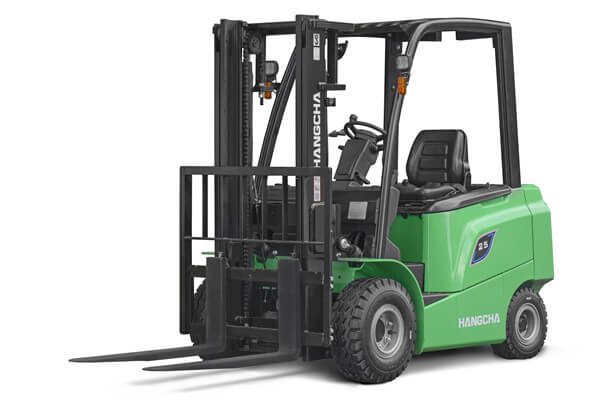
Watch a ForkFocus Electric Forklift Video
The video below provides a practical look at ForkFocus electric forklift equipment. It complements the technology discussion, although the truck shown should not be interpreted as a confirmed sodium-ion production model.
More official forklift videos are available on the ForkFocus China YouTube channel.
VI. Economic and Environmental Impact: A Lifecycle Perspective
Sodium-ion batteries still trail lithium iron phosphate (LFP) batteries in energy density, which limits their use in high-end passenger vehicles. However, this limitation does not prevent sodium-ion technology from developing a strong competitive position in applications where other performance characteristics matter more.
Industry forecasts suggest that sodium-ion batteries could account for approximately 10% of the global battery market by 2035, representing demand of more than 365 GWh. This growth could create a substantial incremental market across energy-storage systems, two-wheelers, commercial vehicles and cost-sensitive vehicle platforms.
The forklift industry has repeatedly adopted technologies that improve safety, operating cost or availability. Related perspectives can be found in our analysis of long-term Chinese forklift industry trends and the China forklift industry report.
Supplementation Rather Than Immediate Replacement
While the industry continues to debate when sodium-ion batteries might replace lithium-ion technology, BYD has already offered its answer through the forklift sector:
not replacement, but supplementation; not disruption, but coexistence.
For forklift buyers, the practical decision should remain application-led. Battery chemistry must be matched to working temperature, shift pattern, charging opportunity, load profile, travel distance, service support and total lifecycle cost.