

Block clamp technology is straightforward in principle: hydraulic cylinders close two arms against a masonry pack, and friction supports the load.
The engineering challenge is making that action controlled, repeatable and compatible with the forklift across thousands of cycles.
Understanding the forklift attachment as a complete mechanical and hydraulic system helps buyers compare more than nominal capacity.
Buyers do not need to design the attachment, but they should understand the components and specifications that determine whether two quotations are truly equivalent.

Watch a ForkFocus Block Clamp in Operation
See how a purpose-built block clamp controls masonry loads in a real ForkFocus operating demonstration.
Frame and Mounting Interface
For a broader specification checklist, review our forklift attachment buying guide.
The frame carries the load from the arms into the forklift carriage.
Its structure affects capacity, visibility, attachment weight and forward thickness.
A compact frame can protect residual truck capacity, but it must still resist repeated bending and shock loads in the intended duty cycle.
Confirm carriage class, mounting height, locking method and any lower-hook adjustment.
The drawing should also show hose routing and clearance through mast movement.
A clamp that fits the carriage but interferes with the mast, load backrest or hoses is not installation-ready.
Arms, Pads and the Force Path
Nonstandard packs may require custom forklift attachment engineering before production.
Arms position the contact pads and transmit cylinder force into the load.
Their height, length and stiffness should match the pack dimensions and contact zone.
Excessive deflection can concentrate force at one edge; a pad that overlaps a void or profile may not use its full area.
Pad material and surface pattern influence friction, wear and marking.
Replaceable pad assemblies simplify service.
For decorative products, the design may prioritize a clean, broad contact; for rough concrete, it may prioritize durable grip.
There is no universal pad that is ideal for every masonry product.
Hydraulic Cylinders and Synchronization
Demanding masonry packs should also be compared with our heavy-load attachment solutions.
Cylinder bore, stroke and system pressure establish available closing force and opening range.
The usable range should cover every approved pack without operating continuously at the mechanical extremes.
Smooth response matters because a rapid initial movement makes alignment difficult and can strike pack edges.
Depending on design, hydraulic circuitry helps the arms move together and maintain stable pressure.
Buyers should ask how synchronization is achieved, what happens when one arm meets the load first and how pressure is limited.
The answer should be connected to the actual pack range, not simply a maximum force figure.
Clamp-Force Control
Several avoidable specification errors are covered in our forklift attachment mistakes guide.
The holding requirement depends on load weight, friction and dynamic conditions.
More pressure is not automatically safer.
Excessive force can chip blocks, crack outer units, mark finished surfaces or deform a pack; insufficient force can allow slip.
Pressure-control arrangements may be fixed, manually selected or integrated with load-dependent systems.
Whatever the method, the approved settings should be documented, protected from casual adjustment and verified during commissioning with representative loads.
Sideshift and Additional Functions
Use our attachment efficiency guide when measuring cycle-time and fleet results.
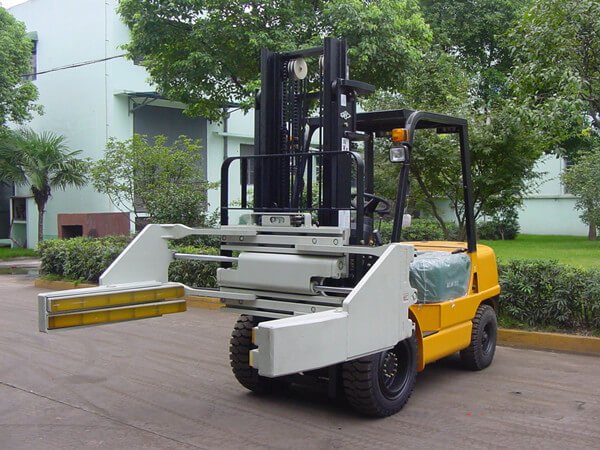
Integrated sideshift lets the operator correct lateral placement without repositioning the truck.
It can shorten cycles in close stacking and trailer work, although stroke, capacity and hydraulic-function requirements must be stated.
Additional movement also changes hose requirements and control complexity.
Confirm how many auxiliary functions the forklift provides and whether a sequencing or solenoid solution is proposed.
The buyer should understand how the operator will control each movement before approving the quotation.
Residual Capacity and Lost Load Center
Warehouse teams can apply these warehouse attachment tips during route and staging reviews.
Attachment weight is only part of the capacity effect.
Frame thickness moves the load center forward, increasing the overturning moment.
The combination of truck, mast, clamp and actual load center must be reviewed by the truck manufacturer or authorized party, with the capacity information updated as required.
Compare quotations using attachment weight, effective thickness or lost load center, rated capacity at a stated load center and the actual pack center—not just the largest number printed in a brochure.
Visibility, Protection and Serviceability
Operator training should also follow these attachment safety practices.
Frame openings, cylinder placement and hose routing affect the operator’s view.
Guards should protect vulnerable hydraulic parts without blocking inspection.
Wear pads, bushings, pins, seals and contact pads should be accessible and identifiable.
Ask for a recommended spare-parts list based on annual cycles and local service capability.
A well-designed clamp reduces unplanned downtime by making normal wear visible and routine replacement practical.
The Application Data That Prevents a Wrong Specification
A reliable recommendation starts with the complete pack range, not one convenient sample.
ForkFocus asks for minimum, typical and maximum pack length, width, height and weight; the block or brick type; the layer pattern; banding or wrapping; and clear photographs from several sides.
We also need to know whether the contact faces are smooth, ribbed, dusty, wet, sealed or easily marked.
These details determine opening range, arm height, pad texture, usable contact area and the force window needed to hold the pack without crushing corners.
The forklift data is equally important.
Make, model, rated capacity, standard load center, mast, carriage class, available hydraulic functions, pressure, flow and hose arrangement should be confirmed before production.
A block clamp adds weight and moves the load forward, so the truck manufacturer or other authorized party must verify the final capacity configuration and update the capacity information as required by local rules.
Finally, describe the real route: pickup position, stacking height, aisle width, floor condition, trailer loading, gradients, outdoor exposure, cycles per hour and shifts per day.
A short handling video often reveals alignment, visibility or pack-consistency issues that dimensions alone cannot show.
Drawings and Testing Buyers Should Request
The approved drawing should show overall dimensions, minimum and maximum opening, arm and pad dimensions, mounting, weight, center-of-gravity information and hydraulic requirements.
Testing should confirm dimensions, mounting, leakage, movement, synchronization, pressure settings and load holding against an agreed procedure.
Photographs and video are useful records, but they do not replace defined acceptance criteria.
Specify what will be checked and which representative pack data the design is based on.
How ForkFocus Turns the Data into a Working Solution
ForkFocus treats a block clamp order as an application-matching project.
Our team reviews the load and truck data, resolves missing information and prepares a general arrangement drawing showing the mounting interface, opening range, arm and pad geometry, overall dimensions and attachment weight.
The drawing gives procurement, operations and maintenance one technical reference before production begins.
Engineering review continues through production and testing.
Mounting, hydraulic movement, synchronization, dimensional range, hose routing and agreed functional requirements are checked before shipment.
This approach cannot replace correct installation or operator training at the destination, but it removes many avoidable errors before the equipment leaves the factory.
Understand Static Holding and Dynamic Handling
A clamp may hold a pack while stationary yet lose margin when the forklift accelerates, turns, crosses uneven ground or brakes.
Engineering therefore considers the static weight together with credible dynamic forces and friction variation.
This is why a successful shop-floor demonstration cannot be reduced to hydraulic pressure alone.
The operating procedure supports the design by controlling travel speed, load height and route condition.
Technology and behavior must agree: no pressure-control system can make abrupt cornering with a raised, unstable pack acceptable.
Specifications Must State Reference Conditions
Capacity, opening range, clamp force and sideshift stroke should be stated with their reference conditions.
Buyers should look for load center, pressure, pack dimensions and permitted motion rather than comparing isolated maximum values.
Clear reference conditions prevent a technically correct number from being applied to the wrong load.
In Conclusion
Block clamp technology works when structure, force, friction, hydraulics and forklift compatibility are balanced around a real masonry pack.
Buyers who compare these elements can distinguish an application-engineered solution from a generic capacity offer.
ForkFocus provides the drawings, technical review and practical testing needed to make that comparison clear before shipment.