

The business case for a block clamp is not the ability to lift a pack during a demonstration.
The real benefits appear across pallet purchasing, yard space, handling cycles, product damage, truck loading and labor.
The financial case is strongest when the forklift attachment removes a measured pallet, damage or cycle-time cost.
For buyers comparing direct clamping with pallet handling, the following benefits should be measured against the actual product range and workflow.
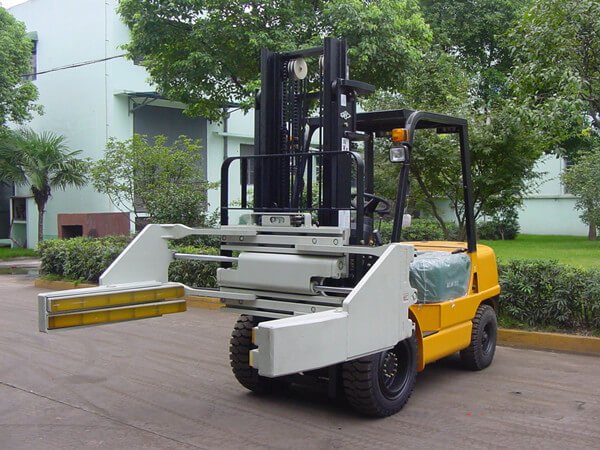
Watch a ForkFocus Block Clamp in Operation
See how a purpose-built block clamp controls masonry loads in a real ForkFocus operating demonstration.
The lowest purchase price rarely produces the lowest cost per handled masonry pack.
A clamp that needs repeated repositioning, damages product edges or causes unplanned maintenance can erase an initial saving quickly.
Benefit Planning Starts with a Baseline
For a broader specification checklist, review our forklift attachment buying guide.
Before requesting quotations, record pack damage, average cycle time, pallet purchases and repairs, truck waiting time, clamp-related downtime and packs handled per shift.
Use the same definitions after commissioning.
This separates real improvement from a busy period, a different product mix or a temporary operator effect.
| Current cost or delay | Block clamp response | Result to measure |
|---|---|---|
| Repeated steering corrections | Integrated sideshift and clearer contact visibility | Seconds per completed placement |
| Chipped corners or pack creep | Correct pad geometry and verified pressure range | Damage by product family |
| Empty-pallet handling | Direct pack movement for approved products | Pallet movements and purchases |
| Hydraulic overheating or leakage | Pressure, flow and duty-cycle matching | Downtime and oil temperature |
| Slow wear-part replacement | Accessible pads, hoses and identified spares | Maintenance hours per event |
Product Protection Is a Financial Benefit
Nonstandard packs may require custom forklift attachment engineering before production.
Block, brick and paver packs can fail in different ways.
Hollow units may crack when force is concentrated through weak outer walls; decorative pavers may show scuffing; wet or dusty packs may creep even when the dry product handled correctly.
A suitable pad spreads force through stable layers and provides enough friction at the lowest credible surface condition.
The approved pressure range should be documented by product family.
Damage records then show whether the problem comes from pack quality, contact position, travel behavior, hydraulic control or pad wear instead of encouraging operators to increase pressure by trial and error.
Hydraulic and Capacity Matching Protects the Return
Demanding masonry packs should also be compared with our heavy-load attachment solutions.
Forklift pressure and flow determine clamp force, speed and controllability.
The truck’s rated capacity, mast, carriage and load center determine whether the combined configuration can carry the pack.
Confirming these inputs before production avoids field hose changes, slow movement and an attachment that leaves too little residual capacity.
Oversizing is not free insurance.
A larger, heavier frame can move the load farther forward and reduce usable truck capacity.
The most productive design is the one that meets the defined load cases with appropriate structural margin while keeping weight and effective thickness under control.
Buy the Feature That Removes a Proven Bottleneck
Several avoidable specification errors are covered in our forklift attachment mistakes guide.
Integrated sideshift is valuable when operators repeatedly correct lateral position.
Selectable pressure is useful when approved product families need materially different force.
Interchangeable pads make sense only when changeover is controlled and frequent enough to justify it.
Each option should be linked to a measured delay, damage mode or maintenance task.
Benefit 1: Lower Pallet Dependence
Use our attachment efficiency guide when measuring cycle-time and fleet results.
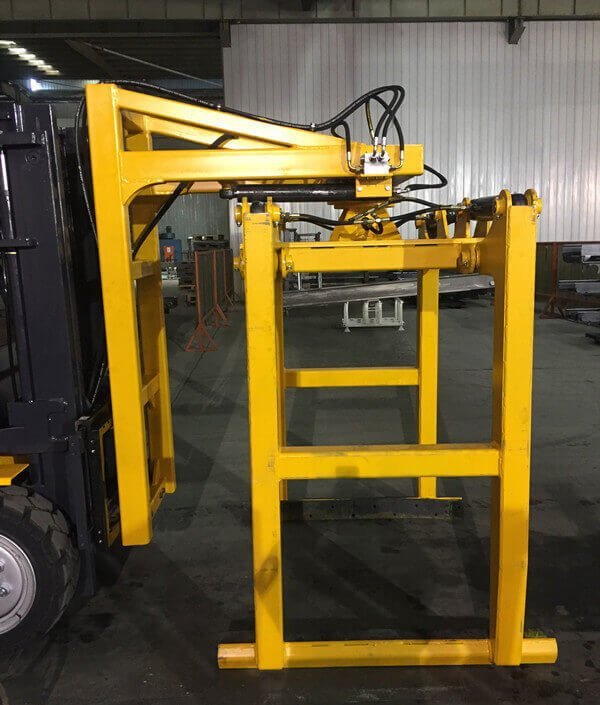
Suitable masonry packs can move directly from production to storage and dispatch without a load-carrying pallet.
This can reduce pallet purchases, repairs, sorting, recovery and the space assigned to empties.
It also avoids delays when the correct pallet is unavailable.
The saving should be calculated honestly.
Some products may still require pallets, export packaging or delivery-specific bases.
Separate the clamp-compatible volume from the exception volume and calculate annual pallet cost for each.
Benefit 2: Fewer Handling Steps
Warehouse teams can apply these warehouse attachment tips during route and staging reviews.
Direct pick-up removes fork entry and pallet alignment.
In a well-designed flow, it may also remove empty-pallet returns and product transfer between pallet types.
Even a small cycle reduction matters when repeated across high daily volumes.
Measure a complete cycle from approach to final release.
Include repositioning, waiting, scanning, trailer access and return travel.
Comparing only the moment of pickup gives an incomplete result.
Benefit 3: Better Use of Yard and Warehouse Space
Operator training should also follow these attachment safety practices.
Pallet storage, damaged-pallet quarantine and return lanes consume space.
Direct pack stacking may improve density where product and site rules allow.
It can also simplify outdoor storage because there is less timber exposed to moisture and ground damage.
Storage benefits depend on stack strength, pack stability, floor condition and retrieval method.
The clamp should not be used to justify a stack arrangement that the product cannot safely support.
Benefit 4: More Consistent Product Handling
A specified pad and pressure range creates a repeatable contact method.
This can reduce random damage caused by fork entry, pallet failure or improvised handling.
The benefit is strongest when product families have defined settings and operators reject unsuitable packs.
Damage should be recorded by SKU, shift and cause.
A falling damage rate is meaningful only when production quality and packaging remain comparable.
Benefit 5: Greater Dispatch Flexibility
A block clamp can move complete packs between yard rows, staging areas and vehicles without waiting for pallet availability.
Integrated sideshift may improve final placement, especially where loads must be close together.
This flexibility helps seasonal operations and mixed production schedules, but the opening range and pad design must cover the full approved mix.
A clamp sized only for the largest pack can be inefficient or unsuitable for smaller formats.
The Application Data That Prevents a Wrong Specification
A reliable recommendation starts with the complete pack range, not one convenient sample.
ForkFocus asks for minimum, typical and maximum pack length, width, height and weight; the block or brick type; the layer pattern; banding or wrapping; and clear photographs from several sides.
We also need to know whether the contact faces are smooth, ribbed, dusty, wet, sealed or easily marked.
These details determine opening range, arm height, pad texture, usable contact area and the force window needed to hold the pack without crushing corners.
The forklift data is equally important.
Make, model, rated capacity, standard load center, mast, carriage class, available hydraulic functions, pressure, flow and hose arrangement should be confirmed before production.
A block clamp adds weight and moves the load forward, so the truck manufacturer or other authorized party must verify the final capacity configuration and update the capacity information as required by local rules.
Finally, describe the real route: pickup position, stacking height, aisle width, floor condition, trailer loading, gradients, outdoor exposure, cycles per hour and shifts per day.
A short handling video often reveals alignment, visibility or pack-consistency issues that dimensions alone cannot show.
Build a Credible Payback Model
Add annual pallet cost, pallet handling labor, damage cost, cycle-time value, space value, planned maintenance and expected downtime.
Compare the proposed clamp with the existing process over a realistic service period.
Include forklift capacity effects and any hydraulic or installation work.
Avoid treating every theoretical second as cash savings.
The strongest business cases link the clamp to a real bottleneck, avoided purchase or measurable quality problem.
How ForkFocus Turns the Data into a Working Solution
ForkFocus treats a block clamp order as an application-matching project.
Our team reviews the load and truck data, resolves missing information and prepares a general arrangement drawing showing the mounting interface, opening range, arm and pad geometry, overall dimensions and attachment weight.
The drawing gives procurement, operations and maintenance one technical reference before production begins.
Engineering review continues through production and testing.
Mounting, hydraulic movement, synchronization, dimensional range, hose routing and agreed functional requirements are checked before shipment.
This approach cannot replace correct installation or operator training at the destination, but it removes many avoidable errors before the equipment leaves the factory.
In Conclusion
The main block clamp benefits are lower pallet dependence, fewer handoffs, more efficient use of space, consistent product contact and flexible dispatch.
Their value is specific to the application and should be measured per handled pack.
ForkFocus helps buyers define that application, select the correct contact system and verify compatibility so the expected benefit can be achieved in daily operation.