

Block clamp innovation is moving from stronger steel toward better control and better information.
The goal is not to add electronics to every clamp; it is to hold variable masonry packs with less damage, less operator guesswork and less wasted movement.
Useful innovation strengthens the core forklift attachment function: controlled contact, predictable movement and serviceable design.
The following developments are changing how buyers specify equipment and how operations measure results.
Watch a ForkFocus Block Clamp in Operation
See how a purpose-built block clamp controls masonry loads in a real ForkFocus operating demonstration.
Block clamp development is moving beyond stronger steel and faster hydraulics.
New designs focus on controlled force, compact integration, useful sensing and information that helps operators and maintenance make repeatable decisions.
Trend 1: Adaptive Clamp-Force Control
For a broader specification checklist, review our forklift attachment buying guide.
Traditional systems use a verified pressure setting for an approved pack family.
Newer arrangements can make it easier to select different settings or adjust force in response to known load data.
This is useful when hollow blocks, dense pavers and architectural products share one truck but tolerate different contact pressure.
The technology still needs a validated force window for each product.
Automatic control cannot correct a broken outer unit, an unstable layer pattern or an unexpected low-friction surface.
Buyers should ask how the setting is chosen, protected, recorded and overridden during a fault.
Trend 2: Electric and Electro-Hydraulic Functions
Nonstandard packs may require custom forklift attachment engineering before production.
Electric control is increasingly used for valve selection, pressure recipes and auxiliary functions such as sideshift.
On electric forklifts, this can simplify communication with the truck and support energy or diagnostic data.
Environmental protection, duty cycle and service capability are decisive.
Masonry dust, water and vibration demand suitable connectors, enclosures and cable routing.
A simpler hydraulic design remains preferable when the operation cannot maintain the added electronics.
Trend 3: Integrated Sensing
Demanding masonry packs should also be compared with our heavy-load attachment solutions.
Pressure sensors, arm-position feedback and load-presence confirmation can warn of incomplete contact or an incorrect recipe.
Cameras may improve visibility in high stacks and trailers.
The strongest systems present a small number of actionable signals instead of overwhelming the operator.
Define the response to every alarm before purchase.
If a sensor detects uneven contact, the procedure may require the load to be lowered and the pack inspected; it should not encourage the operator to continue with more pressure.
Trend 4: Compact Frames with Integrated Sideshift
Several avoidable specification errors are covered in our forklift attachment mistakes guide.
Frame weight and forward thickness reduce the forklift’s available capacity.
More efficient structures and integrated sideshift aim to provide alignment capability with less added mass and lost load center than stacked components.
Compact design must still provide stiffness, visibility and service access.
Buyers should compare attachment weight, effective thickness, rated load-center condition and sideshift capacity rather than accepting the word “integrated” as proof of better performance.
Trend 5: Durable, Replaceable Contact Systems
Use our attachment efficiency guide when measuring cycle-time and fleet results.

Pad development is becoming more application-specific.
Replaceable wear plates, alternative friction patterns and product-specific geometries help one clamp serve controlled load families while keeping maintenance practical.
Interchangeability needs positive identification and a changeover check.
The wrong pad or pressure recipe can be more dangerous than a less flexible fixed design, so the operating system must develop with the hardware.
Digital Product Recipes
Warehouse teams can apply these warehouse attachment tips during route and staging reviews.
Operations that handle several block families increasingly need controlled settings rather than one pressure for every load.
A product recipe can connect SKU, approved pressure range, pad type and contact position.
Whether displayed on the truck or managed through site procedures, the principle reduces memory-based decisions.
The data must remain simple enough for operators to use.
A complex interface that is bypassed does not improve control.
Start with the few product families that create the most volume or damage.
Vision and Position Assistance
Operator training should also follow these attachment safety practices.
Cameras, alignment references and position sensors can help operators see pad contact and placement in high stacks or restricted trailers.
These tools are most valuable where the frame or load blocks the direct sight line.
They support, but do not replace, a high-visibility mechanical design and training.
Buyers should evaluate image delay, lighting, dust protection, cable routing and service support before adding a camera system.
Data for Maintenance and Quality
Cycle counts, pressure events and fault records can support preventive maintenance.
When combined with product-damage data, they help distinguish a pack-quality problem from an attachment or operator issue.
Useful data must answer a decision.
Collecting thousands of signals without ownership or review creates cost rather than insight.
Define who will act on an alarm, how settings are controlled and how records connect to the site’s maintenance system.
Automation-Ready Mechanical Design
Automated or remotely supervised handling needs consistent packs, predictable clamp movement and clear confirmation of contact and load state.
Mechanical tolerances, synchronized arms and repeatable pressure are therefore foundations for automation, not old technology being replaced by software.
Sites considering future automation should document pack variation now.
A clamp designed around uncontrolled loads will not become automation-ready simply by adding sensors later.
Lightweight, Compact Engineering
Advanced analysis and better material placement can reduce unnecessary mass while maintaining stiffness and fatigue life.
Lower attachment weight and forward thickness can preserve more forklift capacity and improve energy use.
Lightweighting must be proven for the duty cycle.
Buyers should ask what load cases and testing support the design rather than accepting low weight as an isolated benefit.
The Application Data That Prevents a Wrong Specification
A reliable recommendation starts with the complete pack range, not one convenient sample.
ForkFocus asks for minimum, typical and maximum pack length, width, height and weight; the block or brick type; the layer pattern; banding or wrapping; and clear photographs from several sides.
We also need to know whether the contact faces are smooth, ribbed, dusty, wet, sealed or easily marked.
These details determine opening range, arm height, pad texture, usable contact area and the force window needed to hold the pack without crushing corners.
The forklift data is equally important.
Make, model, rated capacity, standard load center, mast, carriage class, available hydraulic functions, pressure, flow and hose arrangement should be confirmed before production.
A block clamp adds weight and moves the load forward, so the truck manufacturer or other authorized party must verify the final capacity configuration and update the capacity information as required by local rules.
Finally, describe the real route: pickup position, stacking height, aisle width, floor condition, trailer loading, gradients, outdoor exposure, cycles per hour and shifts per day.
A short handling video often reveals alignment, visibility or pack-consistency issues that dimensions alone cannot show.
Adopt Innovation Without Buying Hype
Begin with a documented loss: product damage, inconsistent pressure, alignment time, capacity limitation or unplanned downtime.
Select the simplest technology that can change that result and define the KPI before purchase.
Run a controlled trial where the operational risk justifies it.
Also confirm service capability.
Sensors, valves and controllers need diagnostics, environmental protection and available replacement parts.
A feature that cannot be supported locally may reduce rather than improve uptime.
How ForkFocus Turns the Data into a Working Solution
ForkFocus treats a block clamp order as an application-matching project.
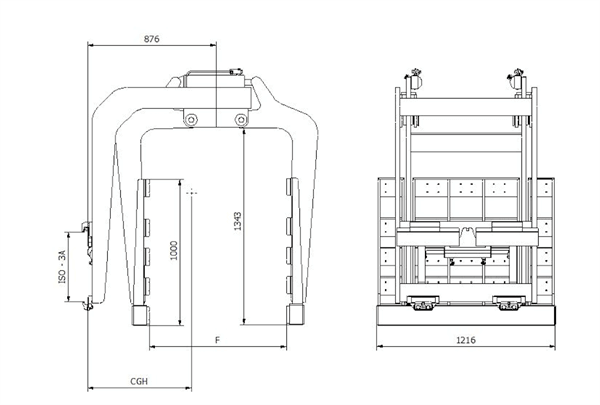
Our team reviews the load and truck data, resolves missing information and prepares a general arrangement drawing showing the mounting interface, opening range, arm and pad geometry, overall dimensions and attachment weight.
The drawing gives procurement, operations and maintenance one technical reference before production begins.
Engineering review continues through production and testing.
Mounting, hydraulic movement, synchronization, dimensional range, hose routing and agreed functional requirements are checked before shipment.
This approach cannot replace correct installation or operator training at the destination, but it removes many avoidable errors before the equipment leaves the factory.
In Conclusion
Block clamp innovation is making load handling more controlled, visible and measurable through force management, sensors, digital recipes, compact structures and automation-ready design.
The useful innovations solve a defined application problem and remain practical to maintain.
ForkFocus combines these options with core attachment engineering so customers can adopt technology at the level their operation can use and support.
Block-clamp improvements should be measured against the load
New arm profiles or pressure controls only add value when they improve grip, reduce damage or simplify a verified handling cycle.
Block clamp product route
Attachment features should be evaluated through load trials and a complete truck-interface check.
No feature substitutes for verified pressure, fit and residual capacity.
Judge each block-clamp feature by contact performance, load damage, cycle control and installed capacity.
- Load range
- Block type, pack dimensions, weight and surface.
- Contact
- Arm profile, pad material and pressure distribution.
- Control
- Hydraulic function, pressure regulation and operator sequence.
- Truck
- Carriage, visibility, mast, route and duty.
- Capacity
- Attachment rating and truck capacity at the working point.
IC forklift range
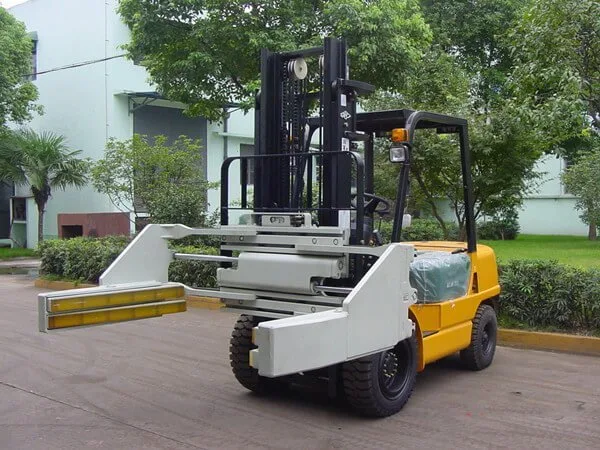
Outdoor masonry yards may favour IC trucks; clean, firm indoor routes may permit electric alternatives.