

Concrete products are heavy, abrasive and rarely as consistent as a drawing suggests.
A block clamp can remove pallets, shorten handling steps and improve yard flow, but only when the clamp, load pack and forklift are engineered as one system.
Among palletless handling options, this forklift attachment is engineered specifically around the geometry and surface behavior of masonry packs.
This article explains where a block clamp creates measurable value and what must be specified before the first pack is lifted.

Watch a ForkFocus Block Clamp in Operation
See how a purpose-built block clamp controls masonry loads in a real ForkFocus operating demonstration.
Start with the Pack, Not the Clamp Capacity
For a broader specification checklist, review our forklift attachment buying guide.
A nominal two-, three- or four-ton rating does not describe how a masonry pack behaves.
Two packs with the same weight may need different pad dimensions and force because their block pattern, contact surface, moisture and banding are different.
The useful starting point is a load map covering every pack the operation expects to handle.
The map should identify which faces can be contacted, whether the outer units carry the full clamping load, and whether voids or projecting edges interrupt the pad.
If only part of the pad touches the pack, local pressure rises even though the hydraulic setting has not changed.
Replace Pallet Movements with Direct Pack Handling
Nonstandard packs may require custom forklift attachment engineering before production.
Where product strength and pack consistency allow it, direct clamping can remove the need to position forks under a pallet, recover empty pallets and manage damaged pallet stock.
The operational change is larger than simply replacing forks: receiving, curing-yard movement, storage and truck loading can be redesigned around complete packs.
The best projects identify the exact handoffs being removed.
Measure the current time to locate a pallet, align forks, pick the pack, return empties and deal with pallet failures.
Then compare that with a controlled clamp cycle.
This creates a realistic business case based on handled packs rather than an assumed percentage improvement.
Control Force Across Real Surface Conditions
Demanding masonry packs should also be compared with our heavy-load attachment solutions.
Dry concrete, sealed pavers, dusty blocks and wet outdoor packs do not offer the same friction.
Pad texture and contact area must be selected for the worst credible condition, while hydraulic pressure must remain low enough to avoid chipped edges, cracked units or visible marks.
Force control is therefore a working range, not one impressive maximum number.
A supplier should explain the relationship between pack weight, friction, dynamic movement, pad area and pressure setting, then identify how operators will select or verify the approved setting for each load family.
Build the Clamp Around the Workflow
Several avoidable specification errors are covered in our forklift attachment mistakes guide.
Arm height affects how force passes through the pack.
Opening range determines whether small and large formats can be handled without running the cylinders at their limits.
Frame thickness changes the load center, and visibility affects alignment in stacks and trailers.
Integrated sideshift can reduce repeated steering corrections where packs are tightly placed.
Service access also matters in high-cycle yards.
Replaceable pads, protected hoses, accessible wear points and common seal sizes make planned maintenance easier.
A durable structure is valuable only if the wear components can be inspected and replaced without lengthy downtime.
The Application Data That Prevents a Wrong Specification
Use our attachment efficiency guide when measuring cycle-time and fleet results.

A reliable recommendation starts with the complete pack range, not one convenient sample.
ForkFocus asks for minimum, typical and maximum pack length, width, height and weight; the block or brick type; the layer pattern; banding or wrapping; and clear photographs from several sides.
We also need to know whether the contact faces are smooth, ribbed, dusty, wet, sealed or easily marked.
These details determine opening range, arm height, pad texture, usable contact area and the force window needed to hold the pack without crushing corners.
The forklift data is equally important.
Make, model, rated capacity, standard load center, mast, carriage class, available hydraulic functions, pressure, flow and hose arrangement should be confirmed before production.
A block clamp adds weight and moves the load forward, so the truck manufacturer or other authorized party must verify the final capacity configuration and update the capacity information as required by local rules.
Finally, describe the real route: pickup position, stacking height, aisle width, floor condition, trailer loading, gradients, outdoor exposure, cycles per hour and shifts per day.
A short handling video often reveals alignment, visibility or pack-consistency issues that dimensions alone cannot show.
Measure Transformation with Operating Data
Warehouse teams can apply these warehouse attachment tips during route and staging reviews.
Track packs per hour, product damage by SKU, pallet purchases, truck waiting time, clamp-related downtime and fuel or energy per handled pack.
Review the figures by shift and surface condition.
A single average can hide a recurring problem on wet packs, one product format or one loading route.
The block clamp has transformed the process when it produces repeatable handling with fewer handoffs and predictable product condition—not merely when it can lift the heaviest demonstration pack.
How ForkFocus Turns the Data into a Working Solution
Operator training should also follow these attachment safety practices.
ForkFocus treats a block clamp order as an application-matching project.
Our team reviews the load and truck data, resolves missing information and prepares a general arrangement drawing showing the mounting interface, opening range, arm and pad geometry, overall dimensions and attachment weight.
The drawing gives procurement, operations and maintenance one technical reference before production begins.
Engineering review continues through production and testing.
Mounting, hydraulic movement, synchronization, dimensional range, hose routing and agreed functional requirements are checked before shipment.
This approach cannot replace correct installation or operator training at the destination, but it removes many avoidable errors before the equipment leaves the factory.
Match the Clamp to Different Block-Pack Families
Hollow blocks often present large voids and relatively thin outer walls, so the pad should load the pack through stable webs and layers.
Dense pavers may tolerate higher contact pressure but can have sealed or decorative faces that show scuffing.
Kerbstones create tall, narrow packs in which arm position and pack restraint become especially important.
Treating these products as one generic “concrete load” hides the design differences that determine reliable handling.
Where several families share one clamp, create an approved matrix for each combination of opening, pad, pressure and contact height.
If one unusual product requires a compromise that makes the main volume less efficient, a second contact-pad set or a separate handling method may be the better investment.
Plan Commissioning with Representative Packs
Commissioning should use more than the heaviest dry pack.
Include the smallest pack, the largest pack, a typical high-volume SKU and a surface condition that represents outdoor operation.
Check pickup, short travel, controlled braking, stacking and release in the real route while following the site’s risk assessment.
Record pressure settings, actual pack condition and operator observations.
Photographs of correct contact position and unacceptable pack defects can then become part of training.
This converts an engineering specification into a repeatable shop-floor standard and gives maintenance a baseline for future troubleshooting.
Repeat the review after operators have completed normal production cycles under representative site conditions.
Early feedback may reveal that a staging mark, hose guard, inspection point or product-specific setting needs adjustment.
Closing these small gaps during commissioning is much less expensive than allowing them to become permanent workarounds.
In Conclusion
A block clamp can transform heavy masonry handling by enabling direct pack movement, reducing pallet dependence and simplifying the path from production to dispatch.
The result depends on application data, controlled force, correct pad contact, verified forklift capacity and a design that matches the real workflow.
ForkFocus combines forklift knowledge, attachment engineering, drawings and practical testing to turn those requirements into a purpose-built handling solution.
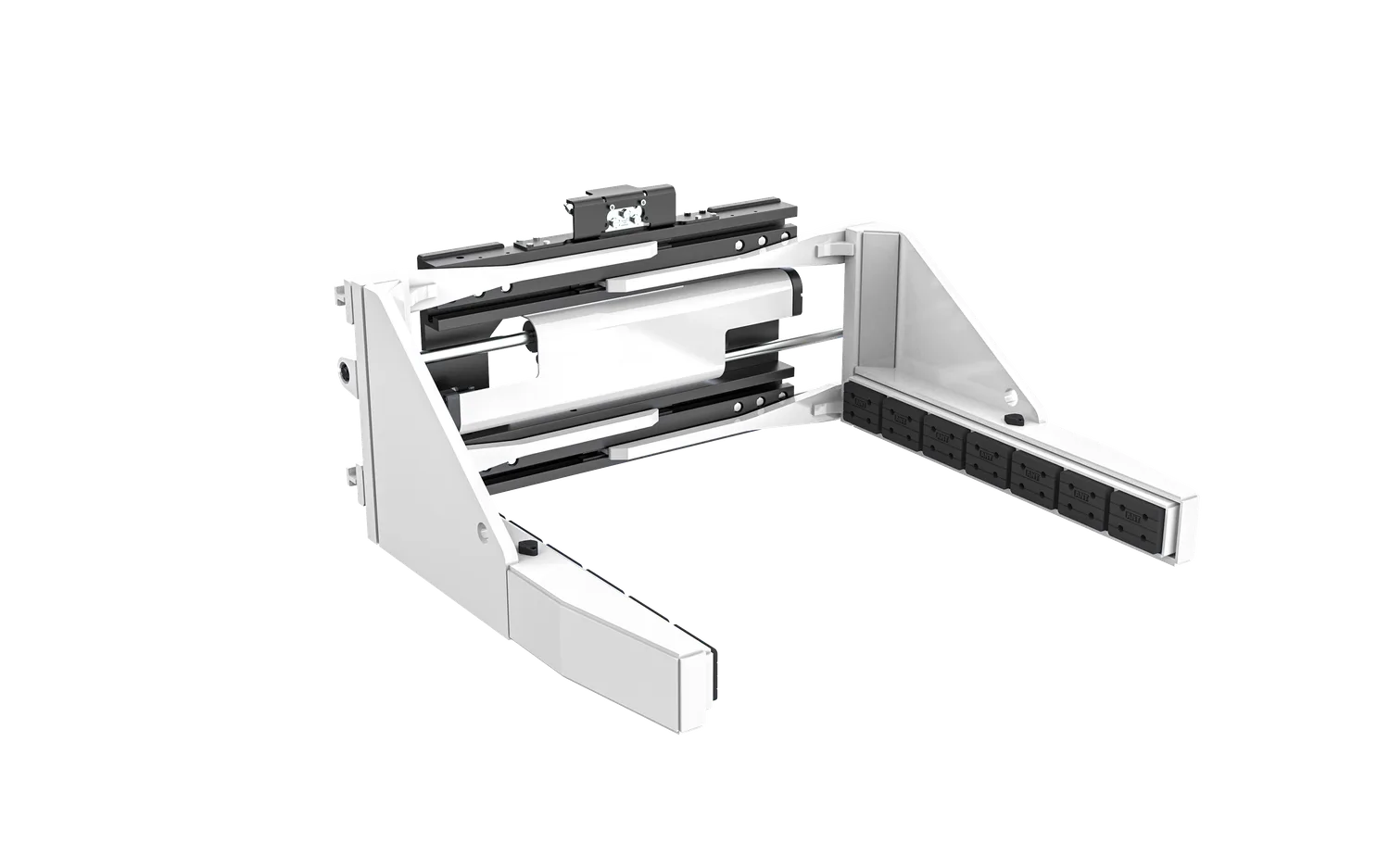
Heavy block handling requires controlled pressure and stable support
Block density, pack size, surface and damage tolerance determine arm geometry and clamping force. The truck must carry the attachment and load at the working point.
Block clamp product route
A block clamp should control the pack without crushing, slipping or forcing the truck beyond its approved working point.
Pressure settings, load trials and capacity require configuration-specific verification.
Use representative load trials to confirm contact pressure, retention and the complete truck-and-clamp working point.
- Load
- Block type, pack dimensions, weight, surface and stability.
- Clamp
- Opening range, arm profile, contact pads and pressure control.
- Route
- Floor, grade, turns, stacking height and visibility.
- Interface
- Carriage, hydraulic functions, pressure, flow and hoses.
- Capacity
- Verify attachment rating and adjusted truck capacity.
IC forklift range
IC forklifts can suit outdoor yards and demanding surfaces; firm indoor routes may allow electric alternatives.