

Request more information?
Tell us how we can we help
Write to us
First reply within 2 hours, Monday–Friday, 09:00–18:00 Beijing time; within 8 hours outside those hours.
Reach us


An electric articulated forklift combines narrow-aisle pallet stacking with travel between the warehouse and suitable outdoor loading areas. Its articulated front section positions the forks towards the rack while the truck manoeuvres in the aisle.
For a small warehouse, the purchasing benefit is better use of the building you already have: less floor space assigned to truck manoeuvring, with more scope for pallet storage.
In markets such as the UK, where land and warehouse space can be costly, compare the proposed rack layout and handling capacity before committing to a larger building.
Check the complete truck and pallet manoeuvre, including entry space and pallet overhang, against your racking layout.
Assess one truck for the loading area and rack aisle, reducing pallet transfers between different machines where conditions permit.
Mast configurations up to 15 m are available. Select the truck by the load it must handle at your highest required position.
The existing ForkFocus range lists a minimum working aisle of 1.9 m. That figure is a configuration reference, not a guarantee for every pallet size, load or warehouse layout.
A pallet with projecting goods needs more space than its nominal base dimensions suggest. Record pallet width and depth, fork-entry direction, maximum load overhang and the narrowest clear distance between racks or other obstructions.
Rack-end cross aisles, staging pallets, columns and doorways affect entry and exit. A narrow rack aisle has little value if the loaded truck cannot turn into it or reach the receiving area.
Send a rack plan or a few dimensioned photos to ForkFocus. We can review the proposed truck configuration against the pallet, aisle and access requirements before quotation.
ForkFocus can offer articulated forklift mast configurations up to 15 m, subject to the selected truck and mast. Maximum lift height and nominal truck capacity are separate specifications.
The truck’s nominal rated capacity must not be assumed to remain available at 15 m. The quotation should identify the available capacity at the required lift height and actual load centre, with any fitted attachment included.
| Warehouse requirement | Configuration to confirm |
|---|---|
| Highest pallet position | Top beam height, pallet-entry clearance and the fork height required to place and retrieve the load. |
| Heaviest load at that height | Exact mast capacity at the actual load centre, using the applicable truck load chart. |
| Doors and overhead restrictions | Lowered mast height, overhead guard height, free lift and roof or service clearances. See the door height and mast clearance guide. |
| High-level positioning | Mast visibility, operator sightlines and available camera or positioning aids for the selected configuration. |
| Attachment fitted | Attachment weight, forward offset, hydraulic functions and the resulting truck residual capacity. Check forklift and attachment compatibility. |
Tell us the heaviest pallet and the highest position you need to reach. A rack drawing or photograph helps; complete technical specifications are not needed for your first enquiry.

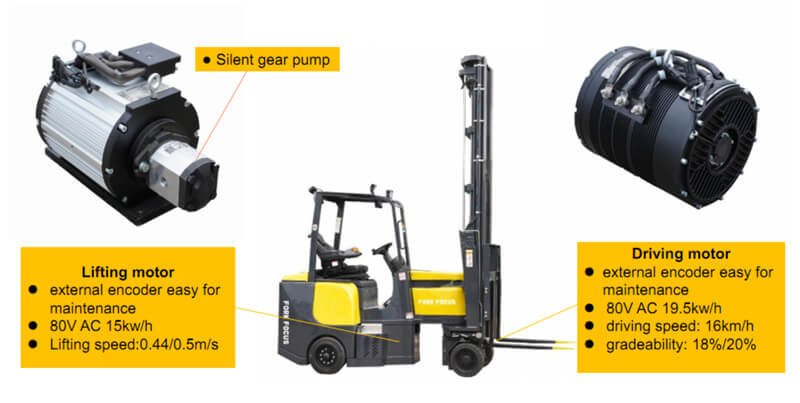
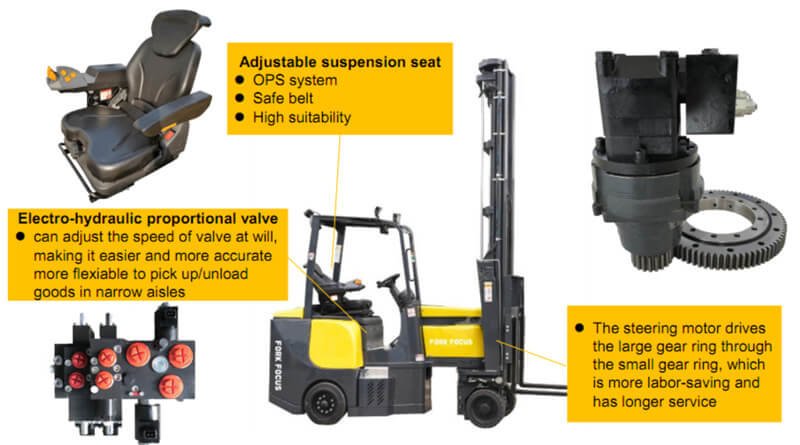


An articulated forklift can also work outdoors. For a warehouse that receives pallets outside and stores them in narrow aisles, this can reduce the need to hand pallets over between an outdoor truck and an indoor truck.
Review paved loading areas connected to the warehouse by suitable doors and manageable gradients. Confirm tyre specification, surface condition, drainage, thresholds and traction for the selected truck.
Match battery capacity and charging opportunities to the full shift, including travel outside the rack aisles. ForkFocus can include the charger and site electrical requirements in the configuration discussion.
Loose gravel, deep potholes, steep slopes, standing water or prolonged weather exposure need separate assessment. Outdoor capability does not make an articulated warehouse truck a rough-terrain forklift.
Provide photos of the worst surface and any ramps. This helps avoid selecting a truck that fits the racks but cannot perform the receiving and dispatch work.
The useful comparison is how each truck handles your pallets, building and daily workload. Narrower aisles alone do not establish the best purchase.
| Truck type | Consider it when | Check before selection |
|---|---|---|
| Electric articulated forklift | You need narrow-aisle stacking and want to assess the same truck for suitable outdoor loading work. | Loaded aisle manoeuvre, rack-end entry, floor and yard conditions, and capacity at the top rack. |
| Seated reach truck | Indoor pallet-racking work is the main duty and the building can accommodate the model's specified aisle requirement. | Working aisle with your pallet, floor condition, lift-height capacity and a separate plan for outdoor handling. |
| VNA turret truck | A dedicated high-density storage installation justifies reviewing turret handling, guidance and the wider warehouse system. | Floor specification, guidance, transfer aisles, throughput, and the truck's exact installation requirements. |
ForkFocus can compare these equipment types against your existing racks or a planned layout. The aim is a workable pallet-handling arrangement, rather than changing the warehouse merely to suit a quoted truck.
We review the pallet and rack layout with the required lift height, then discuss truck capacity, mast, tyres, battery, charger and any attachment. Known-model buyers can send the model, quantity and destination directly.
If you are still comparing equipment, a load description and a few warehouse photos are enough to begin the discussion. We can identify which measurements are needed for the next configuration check.
Agree the destination, shipping scope, documentation and any requested inspection when reviewing the quotation. You can see our real container loading and shipping cases.
Plan model-specific maintenance parts and after-sales communication for your operating hours and local support capability. See forklift spare-parts planning and warranty and after-sales support.
Possibly. ForkFocus needs the clear aisle width, rack-end space, pallet dimensions and required lift height to review a suitable configuration. Rack condition, floor suitability and the loaded truck's manoeuvring clearance still need confirmation.
Do not assume so. The available load at 15 m depends on the exact truck, mast, load centre and attachment configuration; request the applicable capacity data for that working point.
It can be useful when pallet storage is constrained by the building footprint and manoeuvring space. Compare the achievable pallet locations, access and throughput against the cost of the truck, any rack changes and operator training.
No. Send the known model, quantity and destination, or tell ForkFocus what you handle and where. Pallet weight, dimensions, top rack height and a warehouse photo help us develop the configuration with you.